The Future of AI for Small Businesses
 By: Albert Michael - Tuesday, 11 August 2026 14:07:04 • 13 min read
The Future of AI for Small Businesses
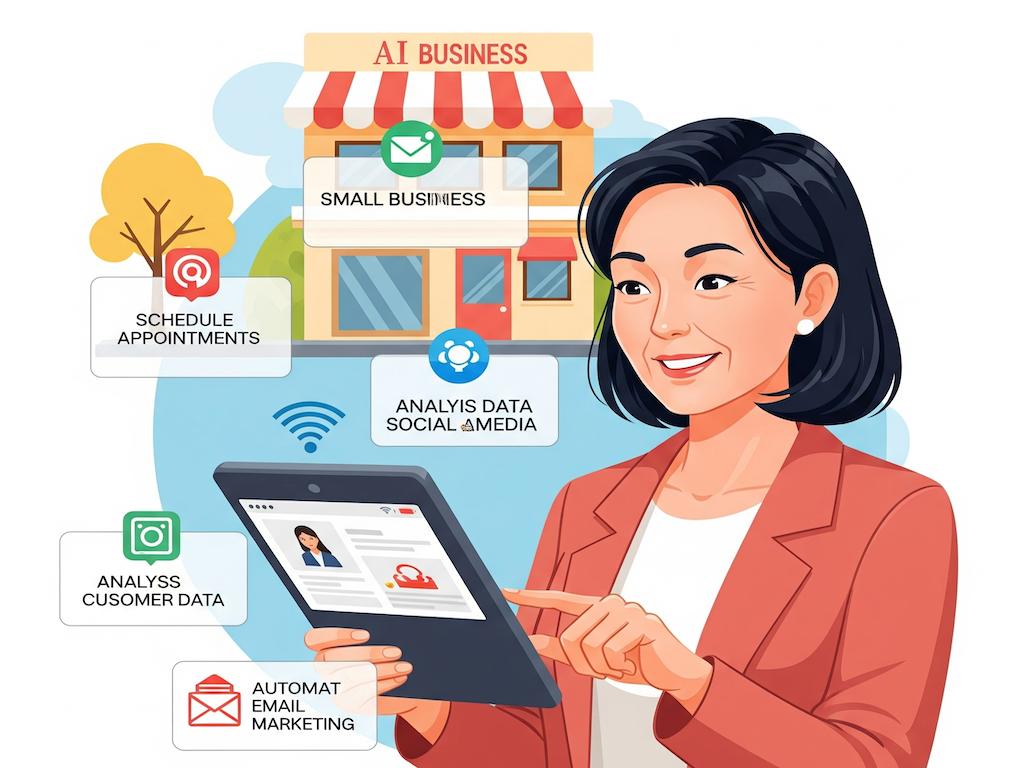
Artificial intelligence is no longer a technology reserved for large corporations with billion-dollar budgets and specialized data science teams. AI is rapidly becoming an accessible business tool for small businesses, startups, freelancers, and growing companies around the world.
The future of AI for small businesses will not simply be about using smarter chatbots or generating content faster. It will increasingly involve AI-powered decision-making, automation, customer service, marketing, financial management, cybersecurity, forecasting, and personalized experiences.
For small business owners, understanding where AI is heading matters because the businesses that learn how to use these technologies effectively may gain significant advantages in productivity, customer experience, and operational efficiency.
What Is the Future of AI for Small Businesses?
The future of AI for small businesses refers to the growing use of artificial intelligence to automate repetitive work, analyze information, improve customer experiences, support employees, and help owners make better business decisions.
Instead of replacing every human task, the most practical future is likely to be one where AI works alongside people. Small businesses can use AI to handle routine activities while employees focus on communication, creativity, relationships, strategy, and other tasks that require human judgment.
This shift is particularly important for small companies because they often operate with limited staff and resources. AI can give a small team access to capabilities that previously required additional employees, expensive software, or external specialists.
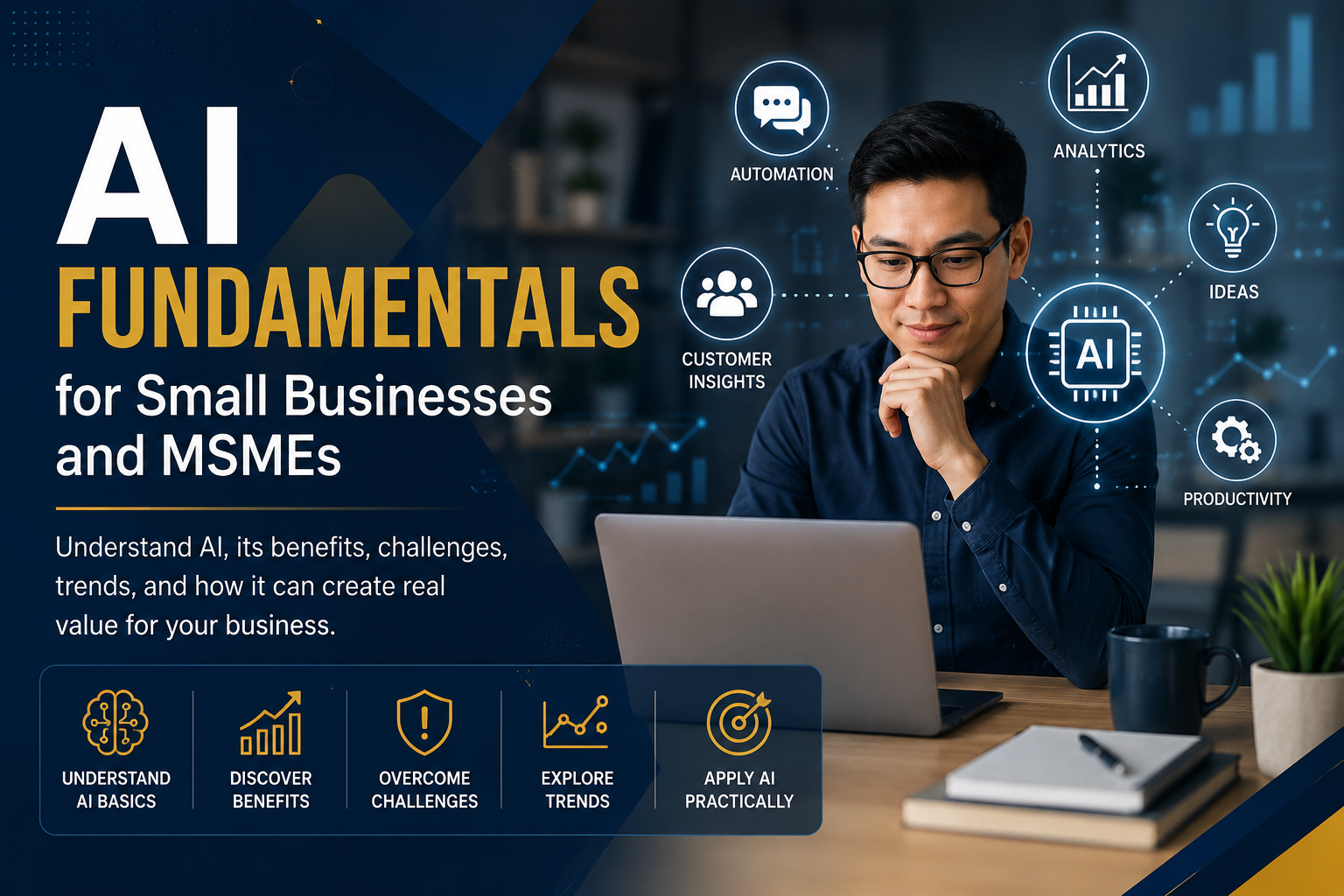
If you are new to the subject, start with What Is AI for MSMEs? The Complete Guide (2026) to understand the fundamentals before exploring the future applications of AI.
Why AI Will Matter More to Small Businesses
Small businesses compete in an environment where customers expect fast responses, personalized experiences, competitive prices, and convenient digital services. At the same time, owners must control costs and manage limited resources.
AI can help address this imbalance by allowing smaller organizations to accomplish more with fewer resources.
For example, one employee could use AI to summarize customer feedback, prepare a first draft of a marketing campaign, analyze sales information, organize meeting notes, and answer common customer questions. These activities do not necessarily eliminate the employee's role. Instead, they reduce the amount of repetitive work surrounding that role.
This is why AI adoption may increasingly become less about having the biggest technology budget and more about knowing how to integrate AI into everyday workflows.
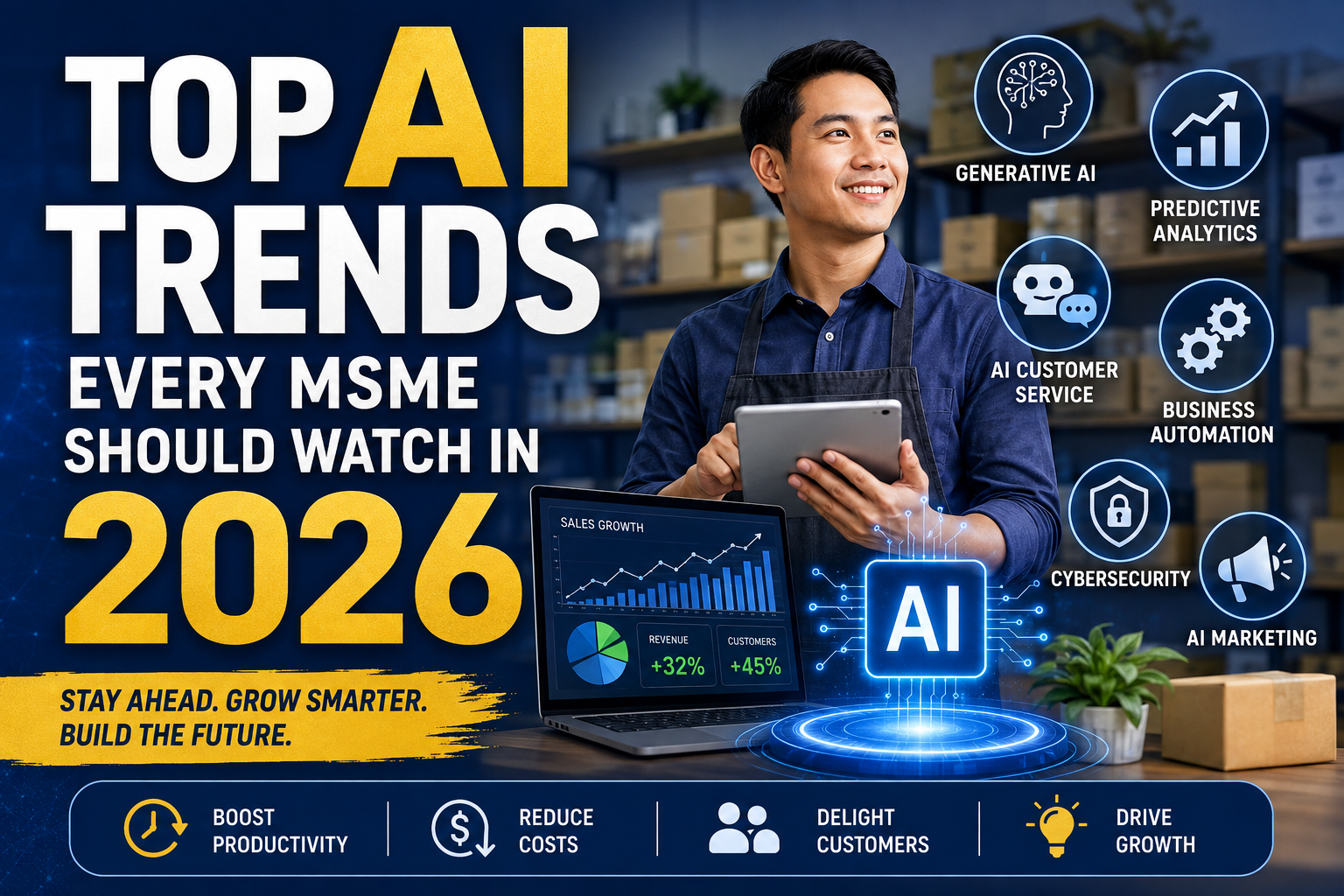
7 Major AI Trends That Will Shape Small Businesses
1. AI Will Become an Everyday Business Assistant
One of the biggest changes will be the evolution of AI from a standalone tool into an everyday business assistant.
Instead of opening a separate AI application for occasional tasks, business owners may increasingly interact with AI directly inside email platforms, accounting software, customer relationship management systems, project management tools, spreadsheets, websites, and communication platforms.
AI assistants will increasingly help users find information, summarize documents, prepare responses, analyze data, create reports, and organize tasks.
For a small business owner, this could mean having an AI assistant that understands parts of the company's workflow without requiring a large technical team.
2. AI Automation Will Move Beyond Simple Tasks
Early business automation often focused on simple repetitive actions. The next stage of AI automation is more sophisticated.
AI systems can increasingly interpret information, make recommendations, and coordinate multiple steps in a workflow.
Consider a small online retailer. An AI-supported workflow could potentially monitor incoming customer questions, categorize them, identify frequently reported problems, draft responses, and notify a human employee when a case requires personal attention.
Human oversight remains important, especially when decisions involve money, legal matters, personal information, or significant customer consequences. However, intelligent automation could dramatically reduce administrative workloads.
3. AI-Powered Customer Service Will Become More Common
Customer expectations are changing. People increasingly expect businesses to provide quick answers regardless of whether the company has five employees or five thousand.
AI-powered customer service can help small businesses provide immediate answers to common questions about products, pricing, opening hours, delivery, returns, appointments, and basic troubleshooting.
The most effective systems will likely combine automation with human escalation. AI can handle predictable requests, while complex or sensitive issues are passed to employees.
This approach allows small businesses to improve response times without attempting to automate every customer interaction.
4. AI Will Make Business Data More Useful
Many small businesses already collect valuable information through sales systems, websites, accounting software, customer databases, social media, and online stores. The problem is that owners may not have enough time or analytical expertise to interpret all of it.
AI can help turn raw information into understandable insights.
For example, an AI system might help identify which products are selling fastest, which marketing channels generate the most leads, which customers are most likely to return, or which periods experience unusually high demand.
The future of AI in small business therefore involves not only generating content but also helping owners understand their businesses.
5. Personalized Marketing Will Become More Accessible
Large companies have traditionally had an advantage in personalized marketing because they can invest heavily in customer analytics and marketing technology. AI is narrowing that gap.
Small businesses can use AI to create customer segments, generate campaign ideas, personalize messages, analyze campaign performance, and identify patterns in customer behavior.
However, personalization should not become intrusive. Businesses need to respect customer privacy and comply with applicable data protection requirements.
The goal should be to make communication more relevant rather than simply collecting as much customer information as possible.
6. AI Will Become More Multimodal
AI is increasingly capable of working with different forms of information, including text, images, audio, video, and structured data.
This multimodal capability could be particularly valuable for small businesses. A restaurant, for example, might use AI to analyze customer reviews, create marketing concepts from photographs, draft social media content, and summarize feedback.
A retailer could use product images and descriptions together to improve product listings. A service business could use voice-based AI to organize notes after customer calls.
As multimodal AI becomes easier to use, businesses may not need to understand the underlying technical systems to benefit from them.
7. AI Skills Will Become a Basic Business Skill
One of the most important long-term changes may be cultural rather than technological.
AI literacy is likely to become increasingly valuable across many business roles. Employees may need to understand how to write effective instructions for AI, verify AI-generated information, protect sensitive data, recognize errors, and determine when human judgment is necessary.
This means the future of AI for small businesses will depend partly on people. Buying an AI tool does not automatically create business value. Employees need to know how and when to use it.
AI Will Not Simply Replace Small Business Employees
One of the most common concerns about the future of AI is job displacement. While AI will certainly change many tasks and workflows, the impact is more complicated than simply replacing humans with machines.
Many jobs contain a combination of repetitive and uniquely human activities. AI may automate certain parts of a role while increasing the value of other responsibilities.
For example, a marketing employee might spend less time creating initial drafts and more time developing strategy, understanding customers, evaluating campaigns, and building the company's brand.
Similarly, a customer service representative might spend less time answering basic questions and more time resolving complicated customer problems.
The most realistic scenario for many small businesses is therefore human-AI collaboration.
The Rise of AI Agents for Small Businesses
Another important development is the emergence of AI agents. Unlike traditional chatbots that primarily respond to questions, AI agents are designed to perform sequences of actions toward a defined objective.
In the future, an AI agent could potentially help manage parts of a sales, customer service, administrative, or marketing workflow.
Imagine a small business receiving an online inquiry. An AI system could identify the customer's request, retrieve relevant business information, prepare a draft response, update a customer record, and notify an employee if human intervention is necessary.
The important consideration is governance. Businesses should define what an AI system is allowed to do, what information it can access, and when a human must approve an action.
Challenges That Could Slow AI Adoption
The future of AI is promising, but adoption will not be completely frictionless. Small businesses still face several challenges.
Cost
Although many AI tools are affordable, businesses can accumulate costs when subscribing to multiple platforms. Owners should evaluate whether a tool produces measurable business value.
Data Privacy
Businesses need to understand what information they are putting into AI systems. Sensitive customer, employee, financial, or proprietary information should not automatically be uploaded to an AI service without considering privacy, security, contractual, and regulatory requirements.
Accuracy
AI systems can produce incorrect or misleading information. Business owners should establish verification processes for important outputs.
Employee Adoption
Employees may resist AI if they believe it threatens their jobs or adds complexity. Training and transparent communication are therefore essential.
Integration
A collection of disconnected AI tools can create more complexity rather than reducing it. Businesses should prioritize tools that integrate well with existing systems and workflows.
How Small Businesses Can Prepare for the Future of AI
Small businesses do not need to predict exactly which AI technology will dominate the next decade. Instead, they should build the organizational ability to adapt.
1. Start With Business Problems
Do not begin by asking, "Which AI tool should we buy?" Start by asking, "Which business problem takes too much time or costs too much money?"
The answer might be customer support, content production, data analysis, scheduling, administration, lead qualification, or internal documentation.
2. Automate Repetitive Work First
Repetitive, predictable tasks are usually a practical starting point for AI. Automating these activities can create measurable time savings while allowing employees to remain responsible for important decisions.
3. Train Employees
AI adoption should include employee education. Staff should understand prompting, verification, privacy, security, and responsible AI usage.
4. Measure Results
AI projects should have measurable objectives. Businesses can track indicators such as hours saved, customer response time, conversion rates, operational costs, content production time, or customer satisfaction.
5. Keep Humans in the Loop
Human review is especially important for decisions involving financial transactions, employment, legal issues, health, personal information, or significant customer impact.
What Will Small Businesses Look Like in an AI-Driven Future?
The small business of the future may operate with a relatively small human team supported by a collection of specialized AI systems.
A business owner might use AI for market research in the morning, analyze sales performance during the afternoon, automatically respond to routine customer questions throughout the day, and use AI-assisted forecasting to plan inventory.
Employees could spend more time on relationships, creativity, strategy, negotiation, product development, and customer experiences.
This does not mean every business will become fully automated. In many cases, the competitive advantage will come from combining technology with human expertise.
Businesses that understand their customers and use AI intelligently may be able to compete more effectively against larger organizations.
AI Adoption Will Become a Competitive Advantage
As AI tools become more accessible, simply having access to AI will no longer be a significant advantage. The competitive advantage will increasingly come from how effectively a business applies it.
Two companies may use the same AI platform but achieve completely different results because their processes, data, employees, customer knowledge, and implementation strategies are different.
This is why AI adoption should be viewed as a business capability rather than a one-time technology purchase.
Small businesses that continuously experiment, measure results, train employees, and improve their workflows may be better positioned for an increasingly AI-driven economy.
Frequently Asked Questions About the Future of AI for Small Businesses
Will AI replace small businesses?
AI itself is unlikely to eliminate the need for small businesses, but it may change how they operate and compete. Businesses that effectively use AI may become more productive and responsive, while businesses that ignore important technological changes could face increasing competitive pressure.
Will AI replace employees in small businesses?
AI can automate certain tasks, but many roles require communication, judgment, creativity, empathy, and accountability. In many cases, AI is more likely to change job responsibilities than completely eliminate them.
Is AI expensive for small businesses?
AI costs vary significantly. Some tools are available at low or no cost, while advanced business systems can require substantial investment. Small businesses should focus on solutions that produce measurable value rather than adopting technology simply because it is popular.
What is the best way for a small business to start using AI?
Start with a specific problem. Identify a repetitive or time-consuming workflow, test an appropriate AI solution, measure the results, and expand only if the experiment creates genuine business value.
What AI skills will small business employees need?
Employees will increasingly benefit from skills such as AI-assisted research, prompt writing, information verification, data literacy, privacy awareness, critical thinking, and effective human-AI collaboration.
Is AI safe for small businesses?
AI can be used responsibly, but businesses need appropriate safeguards. They should understand how AI tools handle data, protect confidential information, verify important outputs, and maintain human oversight over consequential decisions.
What is the biggest AI opportunity for small businesses?
The biggest opportunity may be the ability to increase productivity without proportionally increasing headcount. AI can help small teams automate routine work, analyze information, communicate with customers, and make better-informed decisions.
Final Thoughts: The Future Belongs to AI-Ready Small Businesses
The future of AI for small businesses is not simply about adopting the newest artificial intelligence tool. It is about learning how to combine technology, people, data, and business strategy.
AI will continue to become more capable, accessible, multimodal, and integrated into everyday software. As that happens, small businesses will gain access to capabilities that were once available primarily to large organizations.
The winners will not necessarily be the companies using the most AI. They will be the companies using AI to solve meaningful problems while maintaining strong customer relationships, human oversight, privacy, security, and business judgment.
For small business owners, the best strategy is therefore to start learning now. Experiment with practical use cases, measure results, train your team, and build an adaptable approach to technology.
If you are following this AI for MSMEs series from the beginning, return to What Is AI for MSMEs? The Complete Guide (2026) for the foundational guide, then continue exploring the other articles in the series to understand the benefits, challenges, trends, myths, and practical applications of artificial intelligence for small businesses.
Related AI for MSMEs Articles
- What Is AI for MSMEs? The Complete Guide (2026)
- What Is Artificial Intelligence for Small Businesses? A Beginner's Guide
- Top Benefits of AI for Small Business Owners
- Challenges of AI Adoption for Small Businesses
- Top AI Trends Every MSME Should Watch in 2026
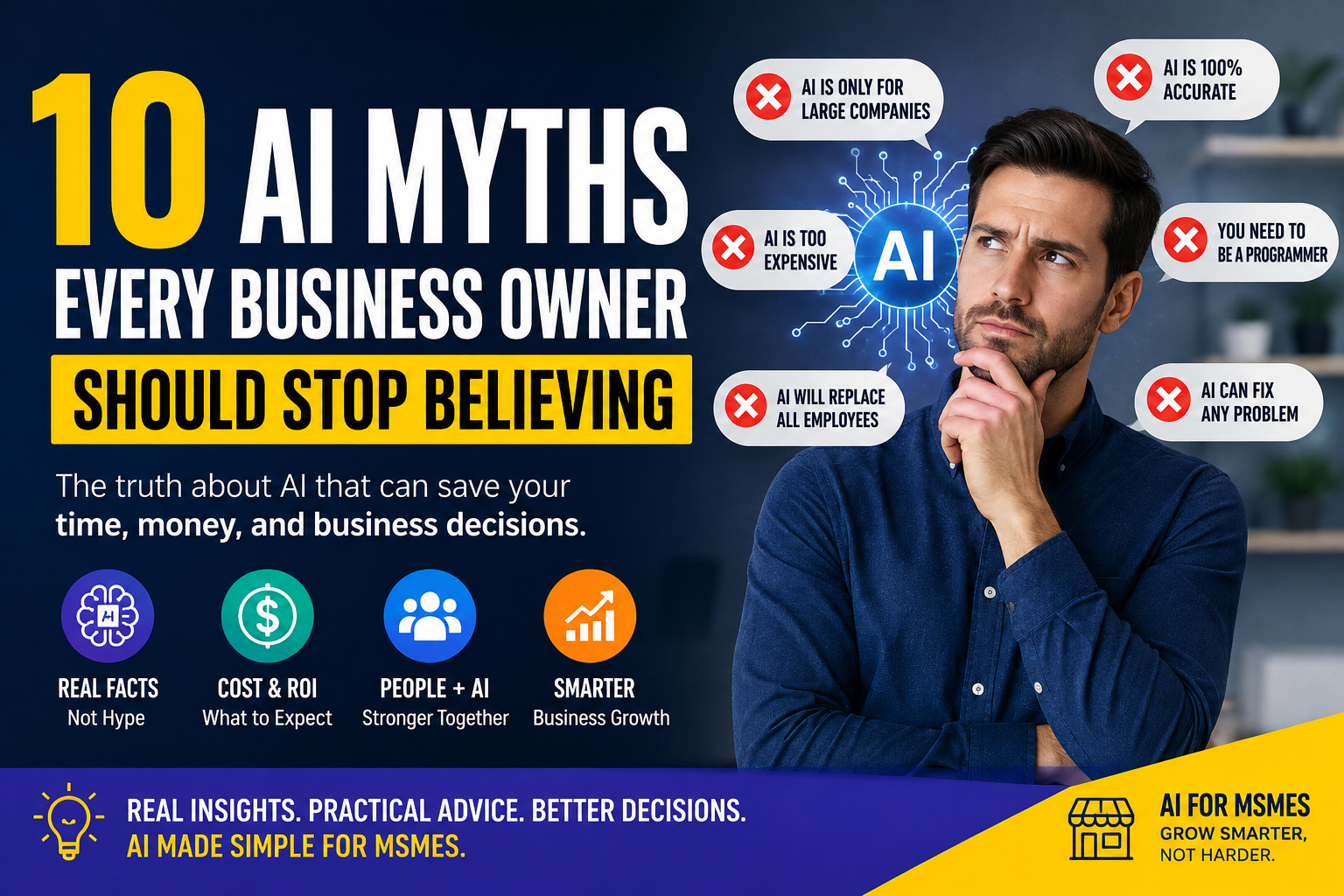
- 10 AI Myths Every Business Owner Should Stop Believing