10 AI Myths Every Business Owner Should Stop Believing
 By: Albert Michael - Sunday, 09 August 2026 22:23:08 • 15 min read
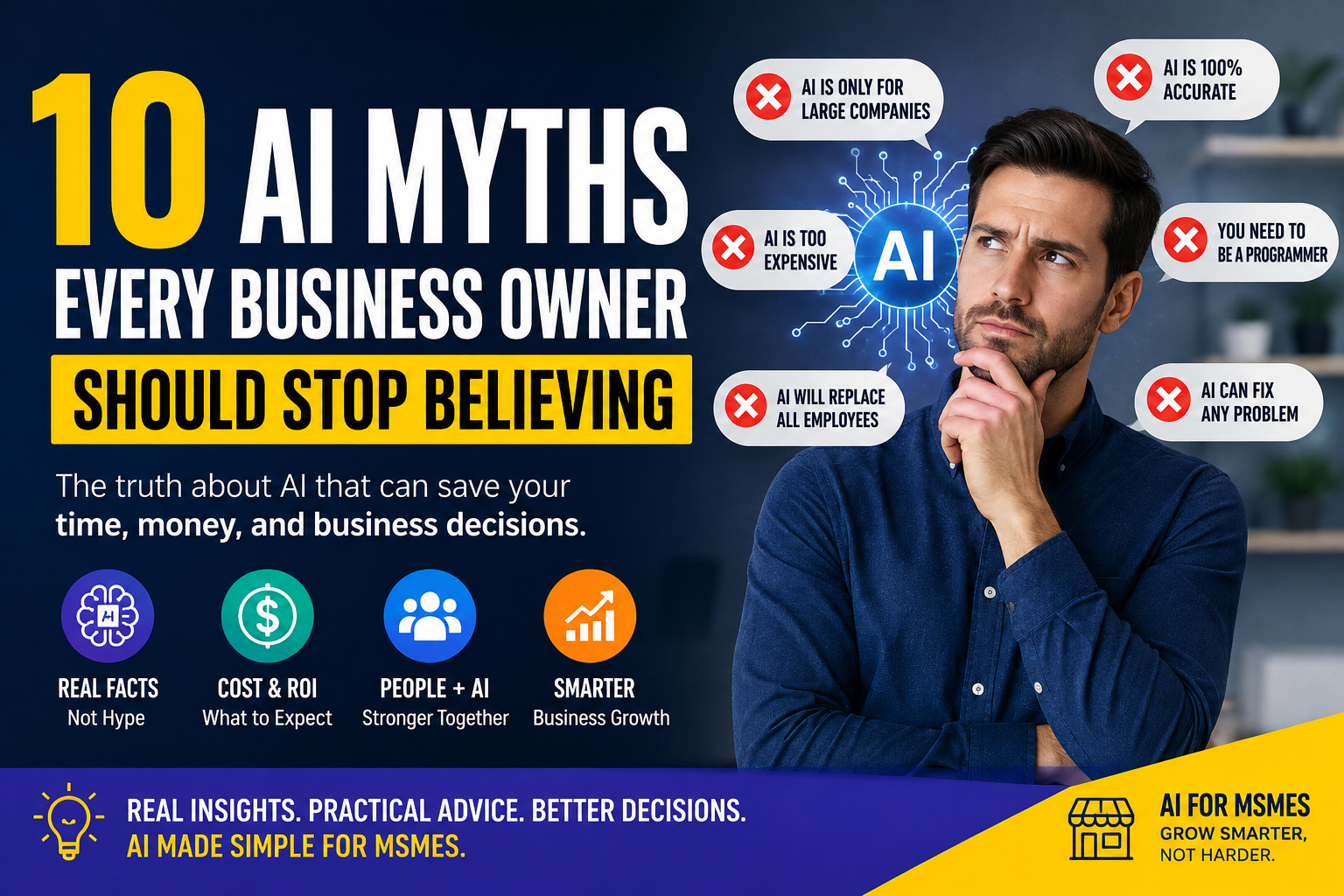
10 AI Myths Every Business Owner Should Stop Believing
Artificial intelligence is no longer something reserved for technology companies and large corporations. Small businesses and MSMEs are increasingly using AI for marketing, customer service, content creation, data analysis, sales, administration, and everyday operations. Yet despite its growing adoption, many business owners still hesitate to use AI because of persistent misconceptions.
Some believe AI is too expensive. Others think it will completely replace employees, requires advanced technical knowledge, or only makes sense for large companies with huge amounts of data. These assumptions can prevent small businesses from discovering practical ways to use AI.
In this guide, we will examine 10 common AI myths that business owners should stop believing in 2026. Understanding what AI can and cannot do will help you make better technology decisions, avoid unrealistic expectations, and identify opportunities where AI can genuinely improve your business.
Why AI Myths Matter for Small Businesses
An AI myth is more than just an incorrect statement about technology. For a business owner, a false assumption can influence whether the company invests in a useful tool, ignores an opportunity, or adopts technology without understanding its risks.
This is particularly important for MSMEs because smaller businesses often operate with limited budgets, fewer employees, and less time for experimentation. Choosing the right technology therefore requires a practical understanding of its potential return on investment.
If you are new to the subject, start with our complete guide to AI for MSMEs, which explains what artificial intelligence is, how it works at a practical level, and why it matters for small businesses.
The goal is not to convince every business to use AI everywhere. Instead, business owners should understand where AI can solve real problems and where traditional processes may still be better.
Myth #1: AI Is Only for Large Companies
One of the most common AI myths is that artificial intelligence is primarily a tool for multinational corporations with large technology departments and enormous budgets.
That may have been closer to reality in the early stages of enterprise AI, but the technology landscape has changed significantly. Cloud-based AI platforms, subscription software, AI assistants, and no-code tools have made many AI capabilities accessible to smaller organizations.
A small retailer, restaurant, agency, freelancer, online seller, or professional service provider can use AI without building its own machine-learning infrastructure.
How Small Businesses Can Use AI
- Drafting marketing content and product descriptions
- Generating ideas for social media campaigns
- Summarizing customer feedback
- Creating first drafts of emails and documents
- Analyzing spreadsheets and business data
- Automating repetitive administrative tasks
- Supporting customer service operations
- Researching markets and competitors
The important question is not whether a company is large enough to use AI. The better question is whether a particular AI application can solve a real business problem at an acceptable cost.
Myth #2: AI Will Replace All Employees
The fear that AI will replace every employee is one of the most widely discussed misconceptions about artificial intelligence.
AI can automate certain tasks, but a task is not the same thing as an entire job. Many jobs contain repetitive activities that can potentially be assisted or automated while still requiring people for judgment, communication, creativity, relationship management, and accountability.
For example, an AI tool may help a sales employee summarize customer conversations, but the employee may still need to understand the customer's needs, negotiate a solution, and build trust.
For small businesses, a more useful way to think about AI is as a productivity tool rather than an automatic replacement for the workforce.
Business owners should identify repetitive tasks first and determine whether AI can help employees spend more time on higher-value activities.
Myth #3: AI Is Completely Autonomous
Another dangerous AI myth is the assumption that modern AI systems can be trusted to operate independently without human supervision.
AI can generate impressive text, analyze information, classify data, summarize documents, and assist with decisions. However, AI systems can also produce incorrect, incomplete, outdated, or misleading results.
This is particularly important when AI is used for financial decisions, legal documents, healthcare-related information, customer complaints, employment decisions, or other sensitive business activities.
Human Oversight Still Matters
A practical approach is to treat AI output as a draft, recommendation, or starting point rather than automatically assuming it is correct.
Employees should review important AI-generated information before it reaches customers or becomes the basis for a significant business decision.
This principle also supports responsible AI adoption: automate where appropriate, but keep humans accountable for important decisions.
Myth #4: AI Always Gives the Correct Answer
AI systems can produce convincing answers even when those answers are wrong. This phenomenon is sometimes described as an AI hallucination.
An AI model does not necessarily "know" whether every statement it generates is factually correct. Depending on the system and task, it may generate a plausible response based on patterns in its training or available information.
For business owners, this means AI-generated content should be checked before publication, especially when it contains statistics, prices, legal requirements, financial information, product specifications, or claims about customers and competitors.
AI is extremely useful for accelerating research and creating first drafts, but verification remains an essential part of a professional workflow.
This is one reason understanding the basics of artificial intelligence for small businesses is important before deploying AI throughout an organization.
Myth #5: AI Is Too Expensive for Small Businesses
Cost is a legitimate concern, but saying that AI is always too expensive for small businesses is an oversimplification.
AI costs vary widely depending on the application. Some tools are available through affordable subscription plans, while others may require significant investment in software development, data infrastructure, integration, and employee training.
Instead of asking whether AI is expensive, business owners should ask:
- What business problem will the tool solve?
- How much employee time could it save?
- Could it increase revenue or customer retention?
- What are the implementation and training costs?
- How much ongoing human supervision is required?
- What happens if the tool does not deliver the expected results?
A relatively inexpensive AI tool that saves several hours every week may provide meaningful value. Conversely, an expensive AI implementation may be a poor investment if it solves a problem the business does not actually have.
This is why AI adoption should begin with business objectives rather than technology trends.
Myth #6: You Need to Be a Programmer to Use AI
Many business owners avoid AI because they believe they need coding skills, machine-learning expertise, or a technical background.
While programming knowledge is valuable for building sophisticated AI systems, it is not required for many everyday AI applications.
Modern AI products increasingly provide user-friendly interfaces that allow people to interact with technology through natural language, dashboards, forms, templates, and visual workflows.
AI Skills Business Owners Actually Need
For many MSMEs, the most valuable skills are not advanced programming techniques. Instead, business owners benefit from learning how to:
- Define a clear business problem
- Write useful instructions or prompts
- Evaluate AI-generated output
- Protect confidential business information
- Check important facts
- Measure whether an AI tool saves time or money
Technical expertise becomes more important when a company wants to build custom AI applications, integrate multiple systems, or develop proprietary models. But using AI effectively does not automatically require becoming a software engineer.
Myth #7: AI Can Fix a Broken Business Process
AI is powerful, but it is not a magic solution for poorly designed business processes.
If a company has unclear responsibilities, inaccurate data, inefficient workflows, or inconsistent procedures, adding AI may simply automate part of the problem.
Consider a business that receives customer inquiries through multiple channels but has no consistent process for recording or responding to them. Installing an AI chatbot may improve response speed, but it does not automatically solve the underlying customer-service process.
A better approach is:
- Identify the business problem.
- Document the existing workflow.
- Remove unnecessary steps.
- Standardize important information.
- Determine where AI can add value.
- Measure the result after implementation.
AI works best when it is integrated into a well-understood workflow rather than added simply because it is fashionable.
Myth #8: More AI Means a Better Business
The rapid growth of AI can create the impression that companies should introduce AI into every department as quickly as possible.
That is not necessarily a good strategy.
Technology should support business objectives. If a manual process is already fast, inexpensive, reliable, and easy to manage, replacing it with an AI system may create unnecessary complexity.
For example, a small business may not need an AI chatbot if its customer volume is low and customers strongly prefer direct conversations with the owner or staff.
The best AI strategy is therefore not "use as much AI as possible." It is "use AI where it creates measurable value."
This distinction is especially important when evaluating the benefits of AI for small business owners. Benefits should be measured against actual business needs rather than assumed simply because a tool uses artificial intelligence.
Myth #9: AI Is Only Useful for Content Creation
Generative AI has become highly visible because of its ability to create text, images, presentations, and other content. As a result, some business owners assume that AI is primarily a content-writing tool.
Content creation is only one possible application.
AI can potentially support many areas of a small business, including:
- Marketing: campaign ideas, audience analysis, personalization, and content drafts
- Sales: lead qualification, sales research, and customer communication support
- Customer service: FAQ assistance, ticket classification, and response drafting
- Operations: workflow automation and document processing
- Finance: data categorization, reporting assistance, and anomaly detection
- Human resources: administrative support and document preparation
- Analytics: identifying patterns and summarizing business information
- Inventory: forecasting and demand analysis where suitable data is available
The best opportunity may therefore be hidden in a repetitive operational process rather than in content production.
Myth #10: AI Adoption Must Happen Immediately
AI adoption is often presented as a race. Businesses may feel pressure to implement new tools quickly because competitors are experimenting with artificial intelligence.
However, adopting AI without a clear purpose can create wasted spending, security problems, employee resistance, inconsistent processes, and disappointing results.
A small business does not need to implement every new AI product that appears in the market.
A more sustainable approach is to start with one high-value use case, test it, measure the results, collect feedback, and then decide whether to expand.
This approach also helps businesses address the real challenges of AI adoption for small businesses, including cost, employee training, data quality, privacy, security, and workflow integration.
What Business Owners Should Believe About AI Instead
Replacing AI myths with realistic expectations is more useful than simply becoming optimistic or pessimistic about the technology.
Here are several practical principles business owners can use in 2026:
AI Is a Tool, Not a Business Strategy
A successful business strategy starts with customers, products, operations, revenue, costs, and competitive positioning. AI can support that strategy, but it should not replace it.
Human Judgment Still Matters
AI can process information quickly, but people remain responsible for interpreting important results, understanding context, and making decisions that affect customers and employees.
Start Small and Measure Results
Businesses can reduce risk by testing one AI use case before making a major investment. Useful metrics might include hours saved, response time, conversion rate, error rate, customer satisfaction, or cost reduction.
Data Quality Matters
AI systems depend heavily on the quality and relevance of the information they receive. Better data generally creates better opportunities for useful automation and analysis.
Responsible AI Is Part of AI Adoption
Businesses should consider privacy, security, intellectual property, transparency, human oversight, and regulatory requirements when implementing AI.
How to Avoid AI Mistakes as a Small Business
Understanding AI myths is only the first step. Business owners also need a practical framework for deciding when and how to use AI.
- Start with a problem. Identify a repetitive, expensive, slow, or difficult process.
- Estimate the potential value. Determine how much time, money, or effort could realistically be saved.
- Choose an appropriate tool. Avoid selecting software simply because it is popular.
- Test before scaling. Run a small pilot and evaluate actual performance.
- Keep humans involved. Establish clear review procedures for important outputs.
- Protect business information. Understand how a tool handles customer, employee, financial, and proprietary data.
- Measure outcomes. Compare results against the original business objective.
This approach makes AI adoption more practical, controlled, and sustainable.
AI Myths vs. Reality: Quick Comparison
| AI Myth | Reality |
| AI is only for large corporations. | Many affordable AI tools are accessible to small businesses. |
| AI will replace every employee. | AI often automates specific tasks while people remain responsible for broader roles. |
| AI works completely autonomously. | Human oversight is important, especially for high-impact decisions. |
| AI always provides correct information. | AI can make factual errors and should be verified. |
| AI is always expensive. | Costs range from low-cost subscriptions to complex enterprise implementations. |
| You must know programming. | Many AI tools can be used without coding. |
| AI can fix broken processes. | AI works better when underlying workflows are already understood and improved. |
| More AI always means better results. | AI should be used where it creates measurable business value. |
| AI is only for content creation. | AI can support sales, service, operations, analytics, and other functions. |
| Businesses must adopt AI immediately. | Testing and measuring use cases can be safer than rushing into adoption. |
The Future of AI for Small Businesses
AI is likely to become increasingly embedded in everyday business software. Rather than always appearing as a separate AI application, AI capabilities may increasingly become part of accounting platforms, customer relationship management systems, marketing tools, e-commerce platforms, office software, analytics products, and communication systems.
This means business owners may not need to become AI experts. Instead, they will need to become better at recognizing useful opportunities, evaluating technology, managing risks, and helping employees work effectively with AI.
The businesses that benefit most may not necessarily be those that adopt the largest number of AI tools. They may be the businesses that identify specific problems and use AI carefully to improve how those problems are solved.
As the technology continues to evolve, staying informed about the top AI trends every MSME should watch in 2026 can help business owners distinguish meaningful developments from short-lived hype.
Frequently Asked Questions About AI Myths
Is AI really useful for small businesses?
Yes. AI can help small businesses with tasks such as marketing, customer service, research, administration, data analysis, and workflow automation. The value depends on whether the selected application solves a real business problem.
Will AI replace small business employees?
AI can automate some tasks, but that does not mean it will automatically replace entire jobs. Many employees can use AI as a productivity tool while continuing to provide human judgment, communication, creativity, and accountability.
Does using AI require programming skills?
No. Many modern AI applications are designed for non-technical users. Programming becomes more important when a business wants to build custom AI systems or complex integrations.
Can businesses trust everything AI generates?
No. AI can produce inaccurate or misleading information. Important facts and business-critical outputs should be reviewed and verified by a qualified person.
Is AI too expensive for MSMEs?
Not necessarily. AI costs vary significantly. Some tools are relatively affordable, while custom AI implementations can be expensive. Businesses should evaluate AI based on expected value and return on investment rather than assuming every AI solution is costly.
What is the biggest AI myth for business owners?
One of the most damaging myths is that AI is either a magical solution or an inevitable replacement for people. In reality, AI is a tool that can provide significant value when it is applied to the right problem with appropriate human oversight.
Should a small business adopt AI immediately?
Businesses do not need to adopt AI simply because competitors are doing so. A better approach is to identify a useful business case, test an appropriate tool, measure the results, and expand adoption when the evidence supports it.
Final Takeaway: Think Beyond the AI Hype
The biggest obstacle to successful AI adoption may not be the technology itself. It may be the assumptions surrounding it.
AI is not exclusively for large corporations. It does not automatically replace every employee, it does not always provide correct answers, and it does not require every business owner to become a programmer.
At the same time, AI is not a magic solution. It cannot automatically repair poor business processes, guarantee better decisions, or create value simply because it has been implemented.
For MSMEs, the most practical approach is to treat AI as a business tool. Start with a genuine problem, identify where AI can help, test the solution, verify its results, protect sensitive information, and measure the impact.
The future of AI for small businesses will not simply be about adopting more technology. It will be about using technology more intelligently.
If you are building your AI knowledge step by step, continue with our complete AI for MSMEs guide and explore the other articles in this AI Fundamentals series to understand the opportunities, limitations, trends, and practical applications of artificial intelligence for small businesses.