Top AI Trends Every MSME Should Watch in 2026 | Future of AI for Small Businesses
 By: Albert Michael - Wednesday, 05 August 2026 21:35:30 • 8 min read
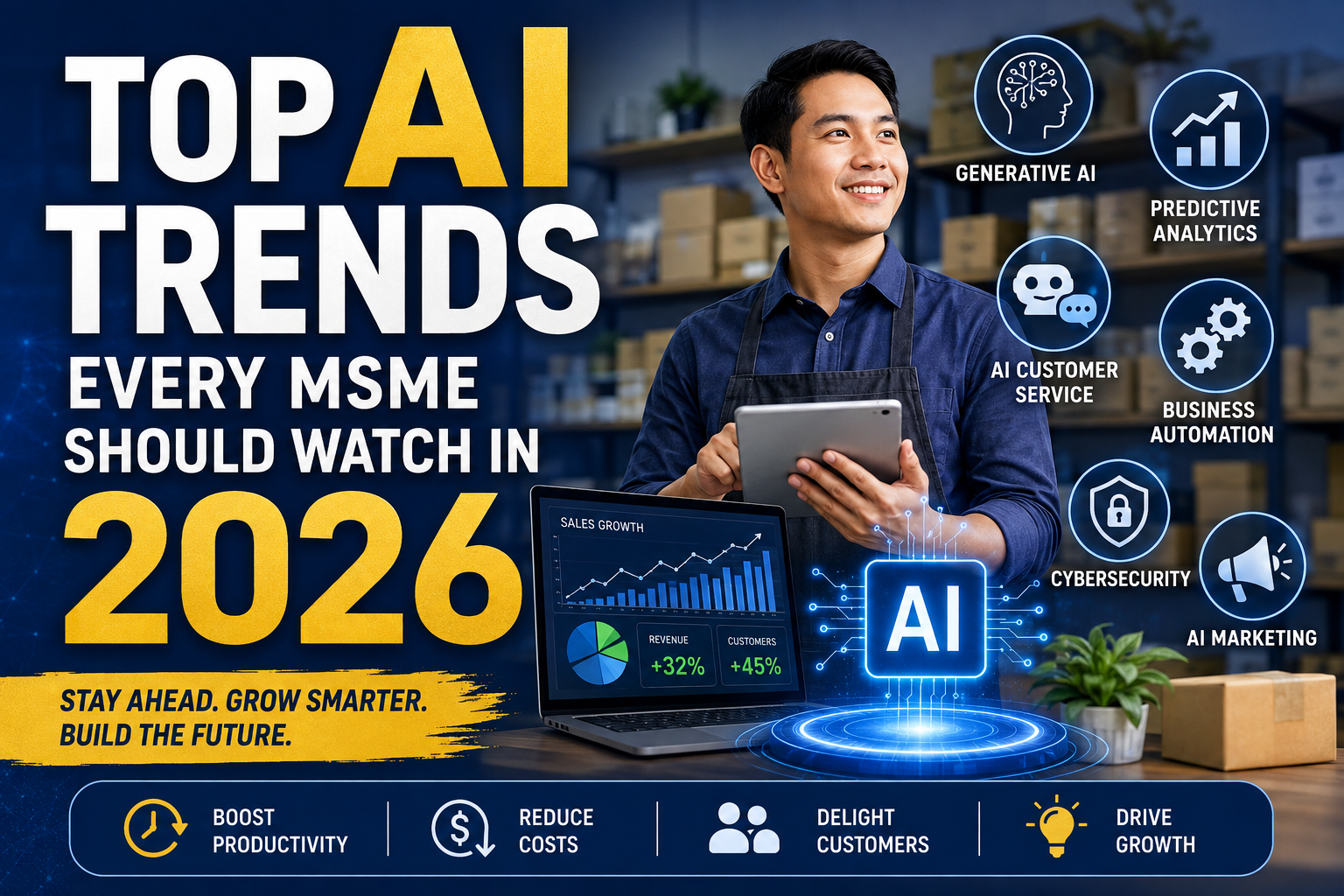
Top AI Trends Every MSME Should Watch in 2026
Artificial intelligence is no longer an emerging technology reserved for global corporations. In 2026, AI has become one of the most influential business tools for micro, small, and medium-sized enterprises (MSMEs) around the world.
From automating repetitive tasks to improving customer experiences, reducing costs, strengthening cybersecurity, and generating valuable business insights, AI is transforming nearly every aspect of modern business operations.
The biggest change is not that AI exists—it is that AI has become accessible. Affordable cloud services, no-code AI platforms, and powerful generative AI assistants have dramatically lowered the barrier to adoption. Businesses with only a few employees can now leverage technologies that were once available only to multinational enterprises.
If you're new to business AI, start by reading our comprehensive guide on What Is AI for MSMEs? The Complete Guide, which explains how artificial intelligence works for small businesses. You may also want to explore Top Benefits of AI for Small Business Owners to understand the measurable advantages before diving into current trends.
If you're completely new to artificial intelligence, start with our What Is Artificial Intelligence for Small Businesses: A Beginner's Guide. It explains the core concepts of AI in simple language before exploring advanced business applications and emerging trends.
This guide explores the most important AI trends every MSME should watch in 2026 and explains how each trend can create practical business value.
Why AI Trends Matter for MSMEs
Technology evolves rapidly, but not every innovation creates meaningful business value. Understanding AI trends helps business owners distinguish between temporary hype and long-term transformation.
Companies that recognize important trends early often gain significant competitive advantages, including:
- Higher productivity
- Lower operational costs
- Better customer experiences
- Improved decision-making
- Faster innovation
- Increased competitiveness
Rather than replacing employees, today's AI increasingly acts as a collaborative assistant that augments human capabilities.
1. Generative AI Becomes a Daily Business Tool
Generative AI has evolved far beyond writing articles. In 2026, it supports nearly every department inside an MSME.
Common Applications
- Marketing copy
- Email campaigns
- Social media content
- Product descriptions
- Customer support responses
- Business proposals
- Meeting summaries
- Translation
- Training materials
Instead of spending hours creating first drafts, business teams can produce quality content within minutes and focus their attention on reviewing, improving, and personalizing the output.
2. AI-Powered Business Automation Expands
Automation is becoming smarter than traditional workflow software. AI can now make decisions, classify information, prioritize work, and continuously improve its own recommendations.
Automation Examples
- Invoice processing
- Expense categorization
- Inventory updates
- Order management
- Email routing
- Appointment scheduling
- Payroll preparation
- Purchase approvals
This reduces repetitive administrative work while allowing employees to concentrate on higher-value activities.
3. AI Assistants Become Every Employee's Digital Coworker
Businesses increasingly deploy AI assistants that function as everyday collaborators rather than simple chatbots.
Employees can ask questions like:
- "Summarize today's sales."
- "Draft a client proposal."
- "Analyze customer complaints."
- "Create next week's marketing calendar."
- "Find inventory shortages."
This trend significantly increases productivity without requiring specialized technical knowledge.
4. Hyper-Personalized Customer Experiences
Modern customers expect businesses to understand their preferences.
AI now helps MSMEs personalize:
- Emails
- Product recommendations
- Promotions
- Website content
- Loyalty programs
- Advertising campaigns
Instead of treating every customer the same, AI analyzes purchasing behavior and delivers individualized experiences.
5. Predictive Analytics Becomes Affordable
Predictive analytics used to require expensive enterprise software.
Today, affordable AI platforms allow small businesses to forecast:
- Future sales
- Customer demand
- Inventory requirements
- Cash flow
- Customer churn
- Seasonal trends
Better forecasting helps business owners make proactive decisions instead of reacting after problems occur.
6. AI-Driven Marketing Continues to Grow
Marketing remains one of the biggest beneficiaries of artificial intelligence.
AI Marketing Capabilities
- Keyword research
- SEO optimization
- Ad targeting
- Campaign optimization
- Audience segmentation
- Content generation
- Email optimization
- Performance analysis
Businesses can create more effective campaigns while spending less time managing marketing operations.
7. AI Customer Service Operates 24/7
Customer expectations continue to rise.
AI-powered support systems now provide:
- Instant responses
- Order tracking
- Product recommendations
- Frequently asked questions
- Appointment booking
- Complaint handling
- Multilingual support
Human agents remain available for complex cases while AI handles routine requests around the clock.
8. AI Strengthens Cybersecurity
Cyber threats are increasing globally.
Modern AI systems can detect unusual behavior before attacks become serious incidents.
AI Security Features
- Fraud detection
- Phishing identification
- Suspicious login alerts
- Malware detection
- Network monitoring
- Risk assessment
This provides an additional layer of protection for businesses with limited IT resources.
9. Voice AI and Conversational Interfaces Expand
Voice technology is becoming increasingly practical in business operations.
Examples include:
- Voice ordering
- Customer support
- Warehouse operations
- Meeting transcription
- Hands-free productivity
Voice AI improves accessibility while increasing operational efficiency.
10. AI for Financial Management
Financial management is becoming more intelligent with AI.
Modern systems assist with:
- Budget planning
- Expense analysis
- Invoice automation
- Profit forecasting
- Tax preparation support
- Cash flow analysis
These capabilities enable business owners to monitor financial health in real time.
11. AI Helps MSMEs Make Faster Decisions
Data-driven decision-making is becoming standard practice.
Instead of manually reviewing spreadsheets, AI can summarize business performance through intuitive dashboards and highlight key opportunities or risks.
Decision-makers spend less time gathering information and more time acting on insights.
12. Responsible and Ethical AI Gains Importance
Customers increasingly value transparency and responsible technology use.
Businesses adopting AI should establish clear policies regarding:
- Privacy
- Data protection
- Human oversight
- Transparency
- Fairness
- Responsible AI governance
Trust is becoming a competitive advantage in the AI era.
How MSMEs Can Prepare for These AI Trends
Start Small
Begin with one business process that consumes significant time.
Train Employees
AI adoption succeeds when employees understand how to collaborate with AI rather than fear it.
Measure Results
Track productivity improvements, cost savings, customer satisfaction, and revenue growth.
Protect Data
Ensure sensitive customer and business information is handled securely.
Continuously Learn
AI evolves rapidly. Businesses that embrace continuous learning remain more competitive.
Common Mistakes Businesses Should Avoid
- Implementing AI without clear objectives
- Ignoring employee training
- Expecting immediate results
- Using poor-quality data
- Neglecting cybersecurity
- Over-automating customer interactions
- Failing to measure ROI
A successful AI strategy focuses on solving real business problems rather than adopting technology for its own sake.
The Future Beyond 2026
Artificial intelligence will continue to become more autonomous, affordable, and deeply integrated into everyday business operations.
Future developments are expected to include:
- AI agents capable of completing multi-step business workflows independently
- Smarter predictive analytics powered by real-time data
- Advanced multimodal AI that understands text, images, video, and audio simultaneously
- More collaborative human-AI workplaces
- Industry-specific AI solutions tailored for retail, manufacturing, healthcare, education, hospitality, and logistics
Businesses that start building AI capabilities today will be better positioned to adapt to these future innovations.
Final Thoughts
Artificial intelligence is no longer a technology of the future—it is an essential part of doing business in 2026. The most successful MSMEs are not necessarily those with the largest budgets, but those that embrace practical AI solutions to improve efficiency, enhance customer experiences, and make better decisions.
Rather than attempting to adopt every new tool, focus on AI trends that directly address your business challenges. Start with manageable projects, measure results, and expand gradually as your organization builds confidence and expertise.
If you're just beginning your AI journey, return to What Is AI for MSMEs? The Complete Guide (2026) for a foundational understanding. Then continue learning with Challenges of AI Adoption for Small Businesses to prepare for common implementation obstacles, and explore Top Benefits of AI for Small Business Owners to identify the opportunities that align with your business goals.
The future belongs to businesses that combine human creativity, strategic thinking, and responsible AI adoption. By staying informed about these emerging trends, MSMEs can remain competitive in an increasingly digital global economy.
Frequently Asked Questions (FAQ)
What is the biggest AI trend for MSMEs in 2026?
Generative AI combined with intelligent business automation is currently the most influential trend because it improves productivity across marketing, operations, customer service, and administration.
Can small businesses afford AI?
Yes. Many AI tools now offer affordable subscription models, free tiers, and no-code platforms designed specifically for small businesses.
Will AI replace employees?
In most cases, AI complements human work rather than replacing it. It automates repetitive tasks so employees can focus on creative, strategic, and customer-focused activities.
Which department benefits most from AI?
Marketing, customer service, finance, operations, and sales all benefit significantly. The greatest impact depends on each organization's priorities.
How should an MSME begin adopting AI?
Start with one business process that is repetitive or time-consuming, measure the results, train employees, and expand gradually as confidence and expertise grow.
Recommended Reading:
- What Is AI for MSMEs? The Complete Guide (2026)
- What Is Artificial Intelligence for Small Businesses: A Beginner's Guide (2026)
- Top Benefits of AI for Small Business Owners
- Challenges of AI Adoption for Small Businesses
- 10 AI Myths Every Business Owner Should Stop Believing
- The Future of AI for Small Businesses