How to Build an AI Strategy for Your Business: A Practical Guide for Small Businesses | Beritaja
 By: Albert Michael - Saturday, 05 September 2026 13:24:06 • 18 min read
How do you build an AI strategy for your business? Start by identifying a real business problem, define the outcome you want to achieve, identify where artificial intelligence can help, choose an appropriate solution, test it on a small scale, establish human oversight, measure the results, and expand only when the benefits justify the investment.
An AI strategy is not simply a plan to purchase AI software. It is a business framework for deciding where artificial intelligence can create value, how it should be implemented, what risks need to be controlled, and how success should be measured.
This matters particularly for small businesses, MSMEs, SMEs, entrepreneurs, and managers that often have limited budgets, employees, and technical resources. AI can support marketing, sales, customer service, operations, productivity, analytics, and decision-making, but not every business problem requires artificial intelligence.
This guide explains how to build a practical AI strategy that connects technology with genuine business needs rather than adopting AI simply because it is becoming increasingly popular.
What Is an AI Strategy?
An AI strategy is a structured plan for using artificial intelligence to support specific business objectives. It connects AI capabilities with priorities such as improving productivity, reducing repetitive work, supporting employees, analyzing information, improving customer experiences, or making better business decisions.
A useful AI strategy answers several fundamental questions:
- Why: What business problem are we trying to solve?
- Where: Which workflow or business function could benefit?
- How: Which AI approach is appropriate?
- Who: Who will use, manage, and review the system?
- How will we know: Which metrics will determine whether the project is successful?
This makes an AI strategy different from simply adopting an AI tool. A tool is an implementation choice; the strategy determines whether that technology should be used and how it should contribute to the business.
Businesses that are still developing their AI fundamentals can first explore the complete AI guide for small businesses to understand the broader role of artificial intelligence in an MSME environment.
Why Small Businesses Need an AI Strategy
Small businesses often need to achieve more with fewer resources. An AI strategy can help owners determine where technology is genuinely useful before spending money on software, integrations, or training.
Without a strategy, businesses may adopt tools because they are popular rather than because they solve an important operational problem. This can lead to unnecessary subscriptions, duplicated software, poorly designed workflows, security concerns, and employees who are unsure how AI should be used.
A strategy provides a decision-making framework before technology is introduced.
| Without an AI Strategy | With an AI Strategy |
| Choose tools because they are popular | Choose technology based on business needs |
| Automate tasks without measuring outcomes | Define success metrics before implementation |
| Implement many projects simultaneously | Prioritize focused, high-value use cases |
| Ignore data and privacy considerations | Evaluate risks before deployment |
| Assume AI output is always correct | Maintain appropriate human oversight |
Understanding the main benefits of AI for small business owners can help identify areas where an AI initiative may be worth investigating, but benefits should always be evaluated against the actual needs of the business.
How to Build an AI Strategy for Your Business
Building an AI strategy does not require a large technology department. A small business can begin with a structured process that connects business priorities with realistic AI opportunities.
Step 1: Start With Business Problems, Not AI Tools
The first step is to identify problems worth solving. Instead of asking, “Which AI tool should we buy?” ask, “Which business process is consuming too much time, creating avoidable errors, or limiting our ability to serve customers?”
Look for tasks that are:
- repetitive;
- time-consuming;
- data-heavy;
- rule-based;
- dependent on processing large amounts of information;
- slowed down by repeated manual work.
For example, an online retailer may spend substantial time preparing product descriptions. A professional services company may spend hours organizing meeting notes. A restaurant may struggle to review large volumes of customer feedback.
These are business problems first and potential AI use cases second.
It is also important to recognize that AI adoption can introduce obstacles. Before choosing a use case, review the common challenges of AI adoption for small businesses, including employee readiness, cost, workflow changes, and implementation complexity.
Step 2: Define the Desired Business Outcome
Once a problem has been identified, define what improvement you actually want.
A useful objective describes a business outcome rather than simply stating that the company wants to “use AI.”
Possible objectives include:
- reduce the time required to draft routine content;
- make customer inquiries easier to categorize;
- help employees summarize large documents;
- identify patterns in sales data;
- support faster preparation of internal reports;
- reduce repetitive administrative work.
The objective should be clear enough that the business can later determine whether the AI project created meaningful value.
Step 3: Map Your Existing Workflow
Before introducing AI, document how the process currently works.
Ask:
- What triggers the workflow?
- What information enters the process?
- Which employee performs each step?
- Which steps are manual?
- Where do delays or errors occur?
- What is the final output?
This prevents a common mistake: automating a poorly designed process.
AI may make an inefficient workflow faster without making it better. Sometimes the best strategy is to simplify the process before adding artificial intelligence.
Step 4: Identify Where AI Fits
After mapping the workflow, determine whether AI can improve one or more specific steps.
Different AI capabilities are appropriate for different business problems.
| Business Need | Potential AI Approach | Example |
| Generate or transform text | Generative AI | Drafting product descriptions |
| Analyze patterns in data | Machine learning or AI analytics | Identifying sales trends |
| Process large volumes of text | Large language models | Summarizing documents |
| Reduce repetitive manual work | AI automation | Routing routine customer requests |
| Support business decisions | AI-assisted analytics | Comparing business performance indicators |
If your team is unfamiliar with the underlying technology, understanding what AI software means for SMEs can make it easier to distinguish between different categories of AI solutions.
For content creation and other knowledge-based workflows, generative AI for small businesses may be particularly relevant. However, generative AI is only one part of the broader AI landscape.
Step 5: Understand the Technology Before Selecting It
Not every AI system works in the same way. Depending on the problem, a business may encounter machine learning, generative AI, large language models, predictive analytics, computer vision, or automation systems.
For example, machine learning for small business can be relevant when a business wants systems to identify patterns from data, while large language models are particularly relevant to applications involving language and text.
The goal is not to become an AI engineer. The goal is to understand enough about the technology to make sensible business decisions.
Step 6: Prioritize AI Use Cases
You do not need to implement every possible AI use case. In fact, starting with too many projects can make an AI strategy harder to manage.
Rank potential opportunities according to:
- business impact;
- implementation effort;
- data availability;
- financial cost;
- risk;
- employee readiness;
- ease of measuring results.
A simple approach is to prioritize opportunities with high potential value and manageable implementation complexity.
For example, automatically summarizing internal documents may be easier to implement than developing an advanced predictive model. A small business may therefore begin with document processing before moving into more complex applications.
Step 7: Look for Repetitive Workflows Suitable for Automation
Repetitive workflows are often good candidates for AI-assisted automation because they involve recurring actions that employees perform repeatedly.
Examples include sorting inquiries, summarizing information, drafting routine communications, organizing documents, or moving information between systems.
Businesses exploring this area can learn more about AI automation and how it can support repetitive business workflows.
However, automation should not be treated as an objective by itself. The workflow should first be understood, and the business should determine whether automation actually improves the outcome.
Step 8: Evaluate Productivity Opportunities
AI can also support employees without fully automating their work.
An AI assistant may help an employee summarize information, prepare a first draft, organize ideas, analyze documents, or perform other preparatory tasks while the employee remains responsible for the final result.
This approach can be particularly useful when the goal is to improve productivity rather than eliminate human involvement.
For more examples, see how AI productivity tools can help small businesses save time.
Step 9: Choose the Right AI Solution
Only after identifying and prioritizing a business problem should you evaluate specific AI tools or platforms.
Consider:
- what the solution actually does;
- whether it fits the existing workflow;
- how employees will use it;
- what data it requires;
- how business information is handled;
- whether outputs can be reviewed;
- total implementation cost;
- whether it can scale if the pilot succeeds.
A sophisticated AI system is not automatically better. For many small businesses, a simple solution that employees understand and consistently use may provide more practical value.
Step 10: Run a Small Pilot
Do not immediately deploy an AI system throughout the company. Start with a controlled pilot.
A pilot allows the business to identify unexpected problems before making a larger investment.
For example, an agency could test AI-assisted research with one employee and one type of client project. A retailer could test AI-generated product-description drafts for a limited selection of products.
During the pilot, monitor:
- time spent before and after implementation;
- quality of output;
- corrections required;
- employee feedback;
- customer impact where applicable;
- unexpected risks or costs.
Step 11: Use AI to Support Better Decision Making
One of the more strategic applications of AI is decision support. AI can help organize information, identify patterns, summarize data, and generate analytical recommendations.
However, AI should generally be treated as a decision-support capability rather than an automatic replacement for managerial judgment.
Business owners interested in this application can explore how AI can support faster and smarter business decisions.
Step 12: Establish Human Oversight
Human oversight should be part of the AI strategy from the beginning, particularly when AI outputs can affect customers, finances, employees, legal obligations, or important business decisions.
AI systems can produce incorrect, incomplete, biased, or inappropriate outputs. Businesses should therefore define which tasks AI can support and which decisions require human approval.
For example, AI may help draft a customer response, but an employee may need to review it before sending. AI may also summarize business data, while a manager remains responsible for interpreting the information and making the final decision.
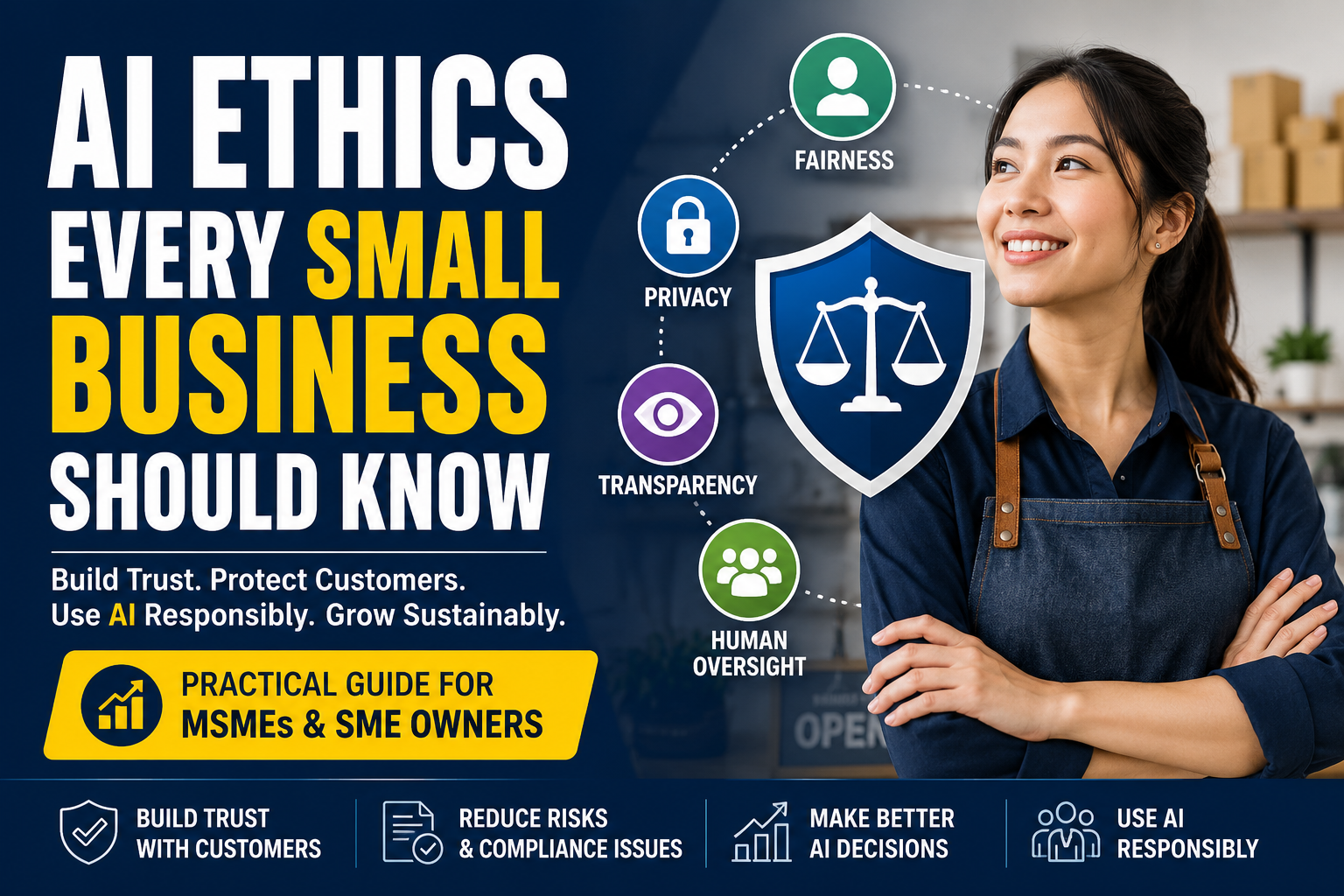
For a broader perspective on responsible implementation, see AI ethics every small business should understand.
Step 13: Protect Business Data
An AI strategy should include rules for handling business information.
Employees may work with customer information, financial records, proprietary documents, employee data, business plans, or other confidential material. Before using an AI service, businesses should understand what information is being processed and what internal controls are necessary.
The AI privacy and data security guide provides additional guidance on protecting business information while using AI systems.
Step 14: Assess AI Risks
AI adoption introduces risks that should be considered alongside potential benefits.
Relevant risks can include:
- incorrect outputs;
- privacy concerns;
- security problems;
- biased results;
- poor-quality input data;
- unexpected costs;
- integration complexity;
- employee training requirements;
- over-reliance on automation.
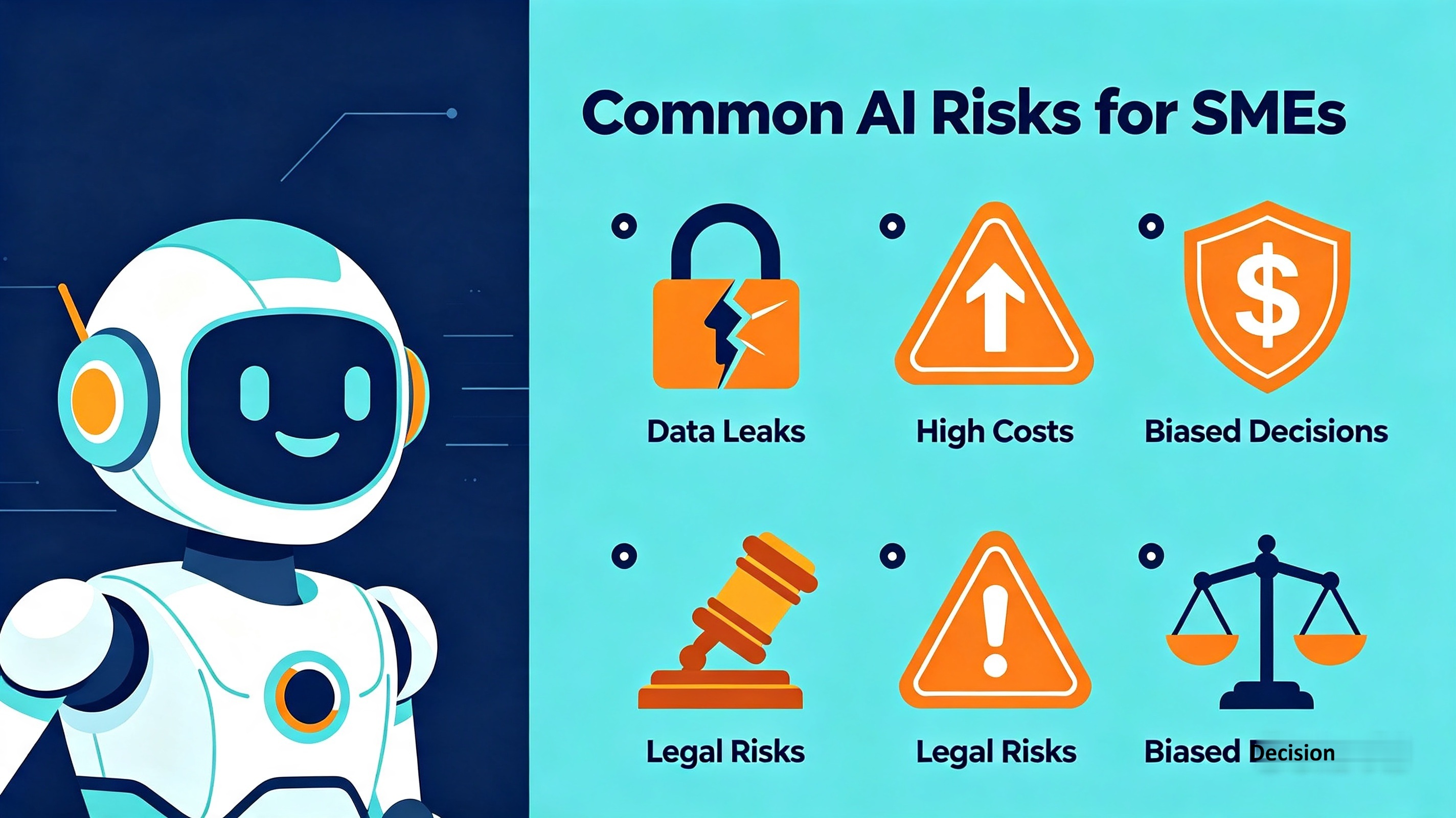
Before expanding an AI project, review common AI risks for SMEs and determine which controls are appropriate for the specific workflow.
Step 15: Measure the Results
An AI project should have measurable objectives. Otherwise, the business cannot determine whether the investment is producing meaningful value.
Depending on the use case, measurements may include:
- time saved;
- number of tasks completed;
- error or correction rate;
- response time;
- employee adoption;
- customer satisfaction;
- operating cost;
- other relevant business outcomes.
Not every benefit needs to be financial. Reducing administrative workload or allowing employees to focus on higher-value work can also be strategically important.
Step 16: Scale What Works
If the pilot produces useful results and the risks are manageable, expand the workflow gradually.
Scaling may involve:
- documenting the process;
- training additional employees;
- establishing usage policies;
- integrating the AI workflow with existing software;
- monitoring output quality;
- reviewing costs;
- evaluating the system regularly.
Do not assume that a successful pilot automatically justifies unlimited expansion. Continue measuring business outcomes as usage increases.
Examples of AI Strategies for Different Small Businesses
The right AI strategy depends on the business model. There is no universal implementation plan.
Retail Business
Problem: Employees spend significant time creating and updating product information.
AI application: Generative AI can assist with initial product-description drafts and categorization.
Expected benefit: Less manual writing and more consistent product information.
Human oversight: Employees should verify specifications, pricing, claims, and product details.
Restaurant
Problem: Management has difficulty reviewing large amounts of customer feedback.
AI application: AI can help categorize feedback and identify recurring themes.
Expected benefit: Faster identification of common customer concerns.
Human oversight: Managers should interpret the feedback and determine which operational changes are appropriate.
Professional Services Firm
Problem: Employees spend substantial time summarizing documents and meeting notes.
AI application: An AI assistant can help create draft summaries.
Expected benefit: Reduced administrative workload.
Human oversight: Important information should be checked against the original source before being relied upon.
E-Commerce Business
Problem: Customer questions arrive through multiple channels.
AI application: AI can help classify routine inquiries and draft responses.
Expected benefit: Faster handling of repetitive questions.
Human oversight: Sensitive complaints, refunds, unusual requests, and complex cases should be escalated to employees.
How AI Strategy Connects With Business Strategy
AI should support the company's broader strategy rather than exist as an isolated technology project.
If the business strategy focuses on customer experience, AI might be evaluated for customer service, personalization, or feedback analysis.
If the strategy focuses on operational efficiency, AI automation and document processing may deserve greater attention.
If growth is the priority, AI might support marketing research, content production, sales analysis, or customer engagement.
This connection matters because technology should serve the business objective—not become the objective itself.
Businesses also need to consider the evolving regulatory environment. Before implementing higher-risk AI applications, review AI regulations every business should understand and verify requirements that apply to the relevant country, industry, and use case.
AI Strategy Areas Small Businesses Should Consider
A practical AI strategy can cover several business functions, but implementation should be prioritized according to actual needs.
| Business Area | Potential AI Role |
| Marketing | Content assistance, research, audience analysis |
| Sales | Lead organization, research, communication assistance |
| Customer Service | Inquiry classification, response drafting, knowledge assistance |
| Operations | Workflow automation and process support |
| Finance | Data organization, reporting assistance, analytical support |
| Management | Data analysis and decision support |
| Human Resources | Administrative assistance and document processing |
Common AI Strategy Mistakes
Choosing Technology Before Defining the Problem
Starting with a tool can encourage businesses to search for problems that fit the technology. Start with the business problem instead.
Trying to Implement Everything at Once
Multiple simultaneous AI projects can overwhelm employees and make it difficult to determine which initiatives actually work.
Ignoring Employees
Employees often understand operational problems better than management or technology vendors. Their feedback can reveal where AI will genuinely help and where it may create additional work.
Skipping Measurement
If success is never defined, businesses may continue paying for systems without knowing whether they provide meaningful value.
Removing Human Review Too Quickly
AI can accelerate workflows, but faster output is not necessarily better output. Human review should remain where accuracy and judgment matter.
Following AI Trends Instead of Business Priorities
AI capabilities change rapidly. A business should avoid changing its strategy every time a new tool or trend appears. The long-term objective should remain connected to the company's customers, operations, finances, and competitive priorities.
For additional context, businesses can review AI trends that small businesses should watch while keeping technology decisions grounded in actual business requirements.
A Simple AI Strategy Framework for Small Businesses
If you need a practical starting framework, use this sequence:
- Business goal: What are you trying to improve?
- Problem: What prevents the business from achieving that goal?
- Workflow: Where does the problem occur?
- AI opportunity: Which part of the workflow could AI realistically improve?
- Risk: What could go wrong?
- Pilot: Can you test the idea on a small scale?
- Measurement: How will you determine whether it worked?
- Scale: Is the result strong enough to justify broader adoption?
This framework keeps the strategy focused on business value instead of technology adoption for its own sake.
It also provides a useful bridge between individual AI experiments and a broader company-wide approach. Businesses that want to understand where AI adoption is heading can also consider the future of AI for small businesses when thinking about longer-term planning.
When AI May Not Be the Right Solution
AI is not always necessary.
A traditional solution may be better when the task is simple, predictable, inexpensive, and already handled efficiently. A straightforward calculation, for example, may not require an AI system when a conventional spreadsheet or calculator provides a faster and more reliable solution.
AI may also be inappropriate when the available data is poor, the business cannot adequately review the outputs, the implementation cost exceeds the expected benefit, or the risks are unacceptable.
A strong AI strategy therefore includes the ability to say no to an AI project when another solution is better.
This is particularly important because businesses may encounter exaggerated expectations about what AI can accomplish. A practical strategy should distinguish genuine capabilities from common misconceptions and AI myths that business owners should stop believing.
Frequently Asked Questions About Building an AI Strategy
What is the first step in building an AI strategy?
The first step is to identify a meaningful business problem rather than selecting an AI tool. Look for repetitive, time-consuming, data-heavy, or information-intensive workflows where improvement can be measured. Once the problem is clearly defined, evaluate whether AI is an appropriate solution.
Does a small business need a dedicated AI team?
Not necessarily. Many small businesses can begin with a small pilot managed by existing employees. The important requirements are clear ownership, appropriate training, defined objectives, risk controls, and human oversight. A dedicated technical team may become useful later if AI adoption becomes more complex.
How much does it cost to create an AI strategy?
The cost varies considerably. Developing the strategy itself can begin with internal planning and process analysis, while implementation may involve software subscriptions, integration, training, data preparation, and other expenses. A business should evaluate total cost against expected business value rather than focusing only on software pricing.
What AI tools should a small business use?
There is no universal list of best AI tools. The appropriate solution depends on the business problem, workflow, data, budget, security requirements, and employee capabilities. Choose the simplest suitable technology that can reliably support the desired business outcome.
Should every business process be automated with AI?
No. AI should be used selectively. Some tasks are better handled by conventional software, documented procedures, spreadsheets, or human expertise. Automation makes the most sense when it solves a genuine problem and the resulting benefits outweigh the cost and risk.
How should businesses measure AI success?
Measure the outcome that the AI project was intended to improve. Depending on the use case, this might include time saved, processing speed, error rates, employee adoption, customer experience, operating costs, or another relevant business metric. Establish the measurement approach before expanding the project.
Why is human oversight important when using AI?
AI can produce inaccurate or inappropriate outputs, so businesses should determine which tasks require human review. Human oversight is particularly important when outputs affect customers, finances, employees, legal obligations, confidential information, or significant business decisions.
How can a small business start using AI without taking excessive risk?
Start with one well-defined, relatively low-risk workflow. Establish a measurable objective, test the process with a limited pilot, review outputs, protect sensitive information, collect employee feedback, and evaluate the results. Expand only after the business has evidence that the approach is useful and manageable.
Conclusion: Build an AI Strategy Around Business Value
How to build an AI strategy for your business ultimately comes down to connecting technology with real business priorities.
Start with a problem. Define the desired outcome. Map the workflow. Identify an appropriate AI opportunity. Evaluate risks. Test the idea on a small scale. Measure the results. Maintain human oversight. Then scale only when the evidence supports expansion.
For small businesses, the best AI strategy is rarely the one with the most AI tools. It is the one that uses the right technology in the right places while protecting data, managing risks, supporting employees, and producing meaningful business value.
Your practical next step is simple: choose one repetitive, information-heavy, or data-driven business process, document how it currently works, and determine whether AI could improve it without introducing unacceptable cost or risk.
For continued learning, explore the AI for MSMEs topical hub for additional guides covering artificial intelligence fundamentals, AI software, automation, productivity, decision-making, ethics, privacy, risk management, and regulations for small businesses.