Common AI Risks for SMEs: How Small Businesses Can Use AI Safely | Beritaja
 By: Albert Michael - Tuesday, 01 September 2026 22:04:52 • 18 min read
Common AI Risks for SMEs: How Small Businesses Can Use AI Safely | Beritaja
Artificial intelligence (AI) can help small and medium-sized enterprises (SMEs) automate repetitive work, analyze information, improve customer service, and create content faster. But AI also introduces risks that businesses need to understand before putting it into important workflows.
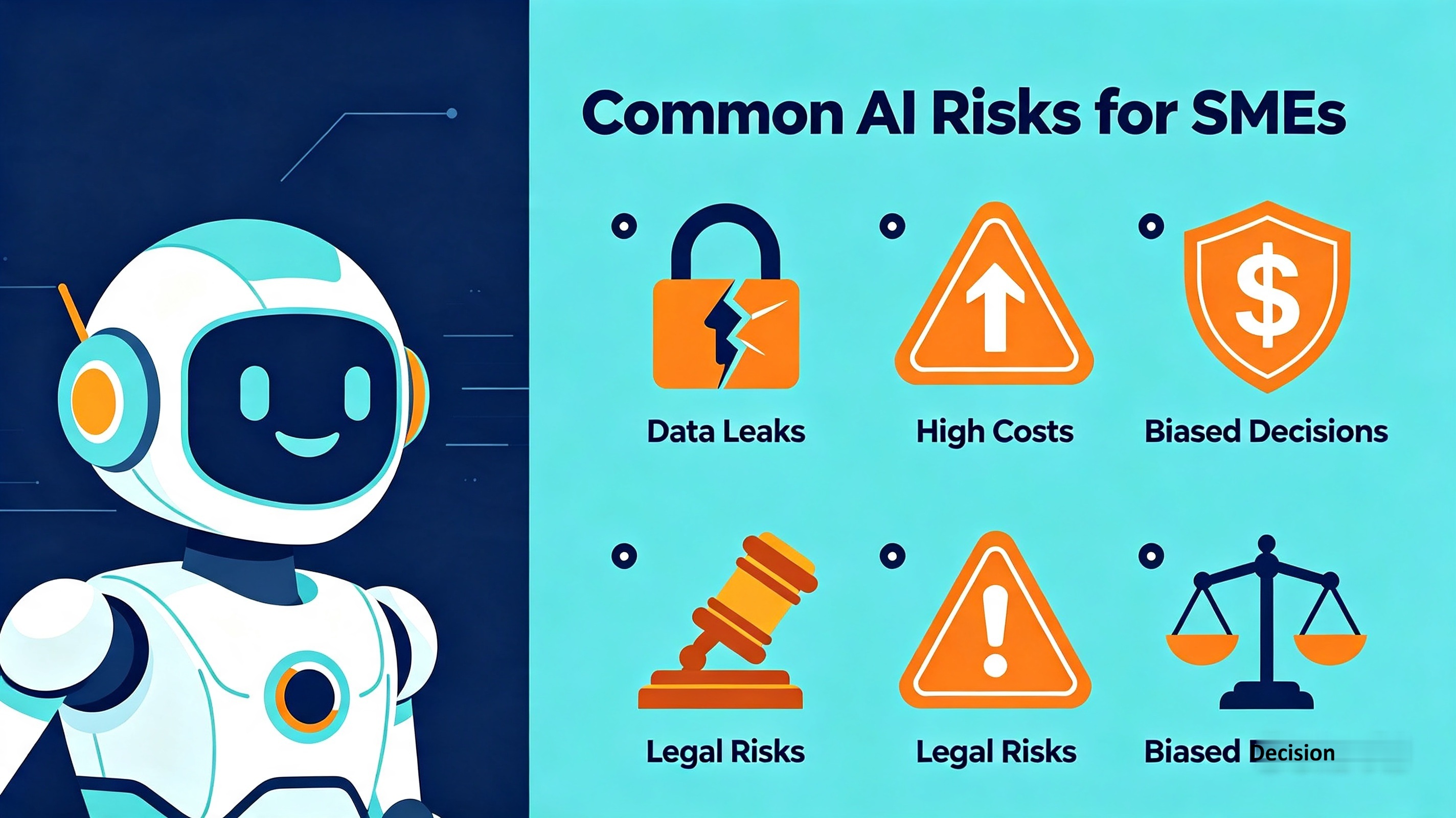
Common AI risks for SMEs include inaccurate AI outputs, data privacy problems, cybersecurity threats, biased results, intellectual property concerns, over-reliance on automation, unexpected costs, and weak human oversight. These risks do not mean small businesses should avoid AI. They mean AI should be introduced deliberately, with appropriate controls and human review.
This guide explains the most common AI risks for SMEs, how those risks can affect everyday business operations, practical examples across different industries, and a simple framework for adopting AI without unnecessarily exposing the business to avoidable problems.
What Are the Common AI Risks for SMEs?
Common AI risks for SMEs are the technical, operational, financial, legal, privacy, security, and human risks that can arise when a small business uses artificial intelligence in its daily activities. The level of risk depends heavily on what the AI system is being used to do, what information it receives, and whether a person reviews its output before action is taken.
A business using AI to brainstorm social media ideas generally faces a different level of risk from a business using AI to screen job applicants, summarize sensitive customer records, recommend financial decisions, or automatically send customer communications.
This distinction is important because AI risk management should be based on the use case, not simply on whether a company uses AI.
| AI Risk | Possible SME Impact | Practical Response |
| Incorrect or fabricated output | Wrong information reaches customers or employees | Fact-check important outputs before use |
| Privacy and data exposure | Confidential or personal information may be mishandled | Control what data employees can enter into AI systems |
| Cybersecurity threats | AI-enabled workflows may create new attack surfaces | Apply access controls, authentication, monitoring, and secure configurations |
| Bias and unfair outcomes | Customers, applicants, or employees may be treated unfairly | Test outputs and retain meaningful human oversight |
| Intellectual property concerns | Content or business materials may create ownership or usage questions | Review AI-generated materials before publication or commercial use |
| Over-automation | Important decisions may be made without adequate judgment | Define decisions that always require human approval |
| Cost and vendor dependency | Unexpected expenses or operational disruption | Monitor usage, pricing, contracts, and alternative workflows |
Why Do AI Risks Matter More for Small Businesses?
AI risks matter for SMEs because a small business often has fewer resources to absorb a major mistake. A large organization may have dedicated legal, security, compliance, data, and technology teams. A small business may have one person handling several of those responsibilities.
This does not mean SMEs need complicated enterprise-level AI governance for every experiment. Instead, businesses should match their safeguards to the potential consequences of the AI application.
For example, an incorrect AI-generated Instagram caption may require a simple editorial review. An incorrect recommendation used to approve a loan, determine employee eligibility, or provide professional advice may require substantially stronger controls.
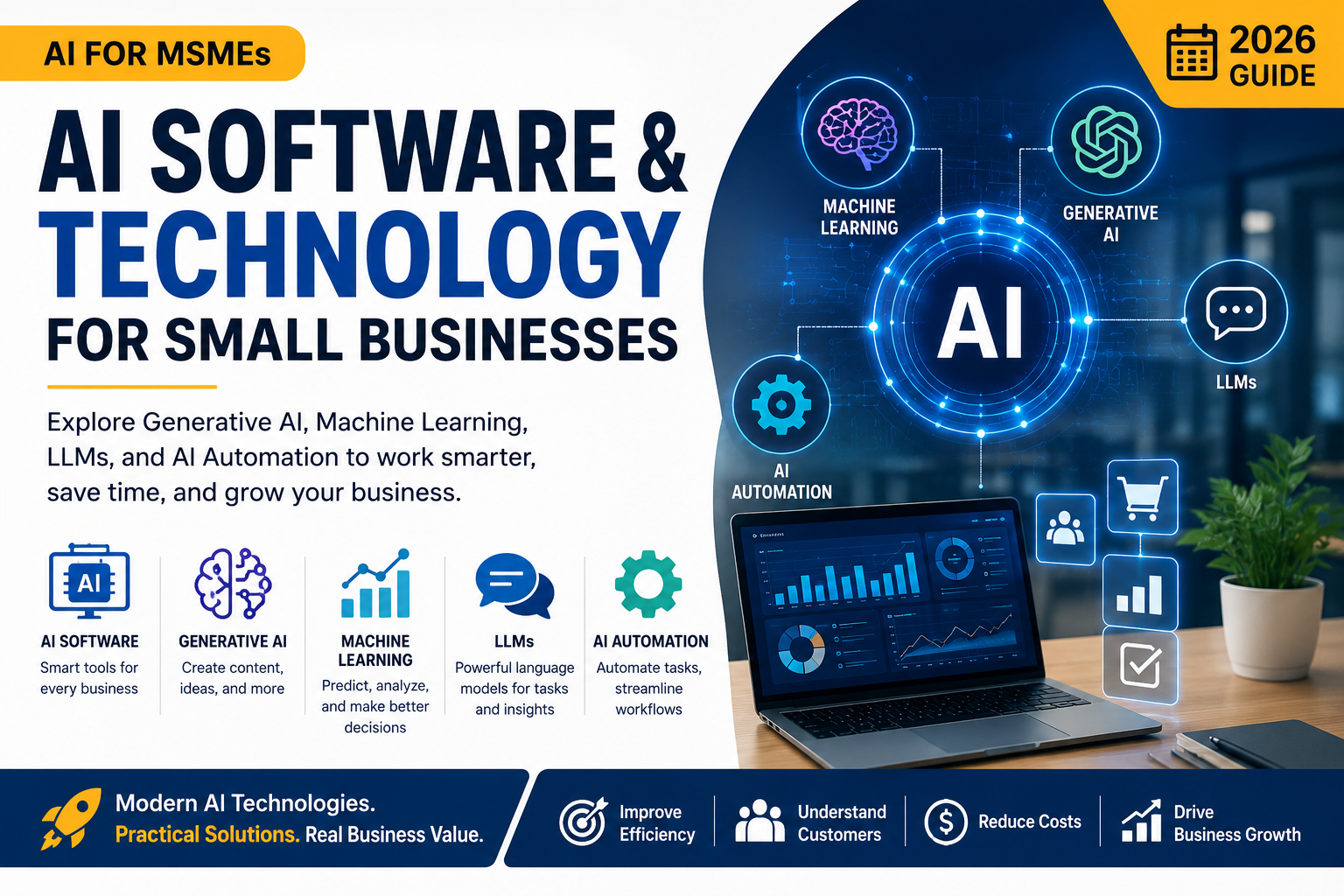
If you are still exploring how artificial intelligence can support your business, start with our AI for MSMEs guide. It provides a broader overview of how small and medium-sized businesses can use AI across areas such as productivity, automation, marketing, customer service, decision-making, and business operations. Understanding these opportunities first makes it easier to evaluate where AI risks may arise and which safeguards are appropriate for each use case.
1. Inaccurate AI Outputs and Hallucinations
One of the most common AI risks for SMEs is trusting an AI-generated answer that sounds convincing but is incorrect. Generative AI systems can produce fluent responses that contain factual errors, unsupported claims, incorrect calculations, or invented references.
NIST uses the term confabulation for cases where generative AI produces erroneous or false content and presents it as if it were reliable. The phenomenon is also commonly called an AI hallucination.
For a small business, this can become a problem when AI-generated information is published or used without verification.
Example
An online retailer asks an AI assistant to write product specifications. The system accidentally invents a product feature that the item does not have. If the business publishes the text without checking it, customers may receive misleading information.
How SMEs Can Reduce the Risk
- Verify important factual claims before publication.
- Check prices, specifications, dates, names, legal information, and numerical calculations manually.
- Do not assume confident language means the information is correct.
- Use authoritative sources when accuracy is important.
- Require human approval for high-impact outputs.
2. Data Privacy and Confidential Information
AI systems can create privacy risks when employees enter personal, confidential, proprietary, or commercially sensitive information into an external service without understanding how that information is handled.
Potentially sensitive information can include customer contact details, employee records, financial documents, contracts, unpublished business plans, passwords, authentication information, supplier information, and confidential communications.
NIST notes that AI can create additional privacy risks, including re-identification risks and the ability to derive additional insights about individuals from data.
Example
A small consulting firm asks an AI service to summarize a client contract. An employee pastes the entire confidential document into the service without first checking the company's data-handling requirements. The problem is not necessarily the act of summarizing the document; the problem is using sensitive information without understanding the applicable privacy and security controls.
Safer Approach
- Classify information before putting it into an AI system.
- Identify information that should never be entered into an unapproved AI service.
- Use approved business accounts and access controls where appropriate.
- Remove unnecessary personal or confidential information.
- Train employees on acceptable AI use.
- Review the privacy terms and security practices of important AI vendors.
SMEs should also consider applicable privacy and data-protection requirements in the countries where they operate and where their customers are located.
3. Cybersecurity Risks From AI
AI can improve cybersecurity workflows, but AI-enabled systems can also introduce security risks. An AI application may interact with business data, software, documents, customer information, APIs, or internal systems. Each additional connection can create another area that needs protection.
NIST identifies security and resilience as important characteristics of trustworthy AI and notes that AI systems can share cybersecurity concerns with other software systems, including risks affecting the confidentiality, integrity, and availability of systems and data.
Common Security Concerns
- Weak account authentication.
- Excessive permissions.
- Insecure integrations with business systems.
- Exposure of sensitive information through prompts or uploaded files.
- Malicious or manipulated inputs.
- Unreviewed AI-generated code.
- Employees using unauthorized AI applications.
A practical rule for SMEs is simple: an AI system should not automatically receive more access than it needs to perform its assigned task.
4. Bias and Unfair AI Decisions
AI systems can reflect limitations in their training data, design, implementation, or surrounding business process. This can create biased or inconsistent outcomes.
Bias becomes particularly important when AI is involved in decisions that affect people, such as recruitment, customer eligibility, pricing, marketing targeting, performance evaluation, or access to services.
Example
A growing company uses an AI tool to rank job applications. If the system consistently favors certain patterns that are not actually relevant to job performance, qualified candidates could be overlooked.
How to Reduce Bias Risk
- Do not treat an AI score as an unquestionable decision.
- Review important outcomes for inconsistencies.
- Use relevant and appropriate criteria.
- Keep humans involved in consequential decisions.
- Investigate unexpected patterns rather than assuming the system is neutral.
NIST's AI risk-management guidance includes fairness and harmful-bias management among the characteristics organizations should consider when evaluating trustworthy AI.
5. Intellectual Property and Content Risks
SMEs increasingly use AI to generate articles, advertisements, product descriptions, images, code, presentations, and other business materials. This can improve productivity, but businesses should not assume that every AI-generated output is automatically free from intellectual-property or licensing concerns.
The exact legal position can depend on the jurisdiction, the AI service, the source material, the way the output was created, and how the business uses the resulting work.
Practical Questions Before Publishing AI-Generated Content
- Did the AI system receive copyrighted or confidential material as input?
- Does the business have permission to use the source material?
- Does the AI provider impose contractual restrictions?
- Has a person reviewed the output for copied or inappropriate material?
- Does the final work need human editing or original creative contribution?
For commercially important material, SMEs should obtain appropriate legal advice rather than relying on a generic assumption that "AI-generated" automatically means "risk-free."
6. Over-Reliance on AI Automation
Automation becomes risky when a business removes human judgment from a process that still requires context, accountability, or professional expertise.
AI can be excellent at generating drafts, organizing information, identifying patterns, or assisting with repetitive tasks. That does not necessarily mean it should be allowed to make the final decision.
Low-Risk Automation
- Drafting internal notes.
- Creating first drafts of marketing copy.
- Summarizing non-sensitive documents.
- Classifying routine information for later review.
Higher-Risk Automation
- Making consequential employment decisions.
- Providing professional advice without qualified review.
- Automatically approving or rejecting important transactions.
- Taking irreversible actions without confirmation.
- Communicating sensitive decisions directly to customers without review.
A useful principle is to automate the process where appropriate while retaining human responsibility for decisions that materially affect people, money, safety, legal obligations, or business reputation.
7. AI Vendor and Third-Party Risks
An SME may not build its own AI system. Instead, it may rely on an external AI provider, software platform, chatbot, analytics service, or automation tool. This creates a dependency on another company's availability, security practices, pricing, policies, and technical capabilities.
Before adopting an AI service for an important business workflow, consider:
- What information will the provider receive?
- Who can access the data?
- How is access controlled?
- What happens if the service becomes unavailable?
- Can the business export its data?
- Can pricing or usage limits change?
- What support is available if something goes wrong?
- Can the AI workflow be replaced or disabled without disrupting the entire business?
The goal is not to eliminate vendors. It is to avoid creating a single point of failure for a critical business operation without understanding the dependency.
8. Unexpected Costs and Poor AI ROI
Not every AI implementation produces enough value to justify its cost. Expenses may include subscriptions, API usage, implementation work, integrations, employee training, data preparation, monitoring, and maintenance.
A small business can also lose money indirectly if employees spend significant time correcting low-quality AI output.
Measure the Business Outcome
Instead of asking only, "Does this AI tool work?", ask: "Does this AI workflow improve a measurable business outcome enough to justify its total cost?"
| Measure | Useful Question |
| Time | How much employee time is actually saved? |
| Quality | Is the output accurate enough for the intended task? |
| Cost | What is the total monthly or annual cost? |
| Risk | What could happen if the AI makes a serious mistake? |
| Scalability | Does the workflow remain useful as usage grows? |
9. Employee Skills and Shadow AI
One overlooked AI risk for SMEs is the use of AI tools without a shared company policy. Employees may adopt different tools independently because they are convenient, inexpensive, or easy to access.
This can result in inconsistent practices. One employee may understand what information is safe to upload, while another may unknowingly submit confidential customer information to an unapproved service.
A Simple SME AI Policy Can Define
- Which AI tools employees are allowed to use.
- What types of information may be entered.
- Which information is prohibited.
- When human review is required.
- Who approves AI tools for business use.
- How employees should report an AI-related incident.
- Which decisions cannot be delegated entirely to AI.
The policy does not need to be a long legal document. For many SMEs, a clear one- or two-page internal policy can provide a useful starting point.
10. AI Risks Across Different Small Business Types
AI risks look different depending on the business model. The following examples are hypothetical and are intended to demonstrate how the same technology can create different risk profiles.
| Business Type | Problem | AI Use | Expected Benefit | Human Oversight |
| Retail | Large volume of product descriptions | Generate first drafts | Faster content production | Check specifications and claims |
| Restaurant | Frequent customer questions | Draft FAQ responses | Faster customer service | Review sensitive or unusual requests |
| E-commerce | Large customer-message volume | Classify and summarize inquiries | Better workflow organization | Escalate complaints and sensitive cases |
| Agency | Repetitive research and drafting | Generate research summaries | More efficient preparation | Verify facts and sources |
| Freelancer | Administrative workload | Draft emails and proposals | Less repetitive work | Review tone, accuracy, and client information |
| Professional services | Large volumes of documents | Summarization and organization | Faster document review | Protect confidential information and verify conclusions |
How Should an SME Start Managing AI Risks?
SMEs do not need to solve every possible AI risk before experimenting with the technology. A better approach is to begin with a small, clearly defined workflow and progressively introduce controls as the business learns what works.
- Identify the task. Choose a repetitive, time-consuming, or information-heavy process where AI could provide a clear benefit.
- Define the desired outcome. Decide what successful AI assistance should actually achieve.
- Classify the risk. Consider whether the task involves sensitive data, money, legal obligations, customers, employees, reputation, or other consequential decisions.
- Choose an appropriate AI approach. Select a tool or workflow that matches the task instead of adopting AI simply because it is available.
- Start with a limited test. Test the workflow using low-risk information before expanding its use.
- Check output quality. Measure accuracy, consistency, usefulness, and the amount of human correction required.
- Add human oversight. Define which outputs require approval before they are published or acted upon.
- Measure the result. Compare the time, cost, quality, and risk before and after implementation.
- Expand gradually. Increase automation only when the business has evidence that the workflow is useful and manageable.
A Practical AI Risk Checklist for Small Businesses
Before using AI in a new business workflow, ask the following questions:
- What exactly is the AI being asked to do?
- What happens if the AI is wrong?
- Does the workflow involve personal or confidential information?
- Who can access the AI system?
- Does a person review important outputs?
- Could the AI produce biased or inconsistent results?
- Could the workflow create legal or intellectual-property concerns?
- What happens if the AI service becomes unavailable?
- What does the workflow cost at realistic usage levels?
- Can the business turn the AI workflow off without serious disruption?
If several answers are unclear, the business should pause before expanding the workflow. Uncertainty itself is a useful signal that the process needs more evaluation.
How AI Ethics, Privacy, and Risk Management Fit Together
AI risk should not be treated as a completely separate topic from AI ethics and data security. These areas overlap because decisions about how AI is designed and used can affect customers, employees, business partners, and the wider community.
For example, protecting customer information is both a privacy concern and an ethical responsibility. Reviewing an AI-assisted hiring process for unfair outcomes involves both risk management and responsible business practice.
SMEs building an AI governance approach can therefore benefit from connecting their risk controls with their broader policies for privacy, cybersecurity, employee responsibilities, and business decision-making.
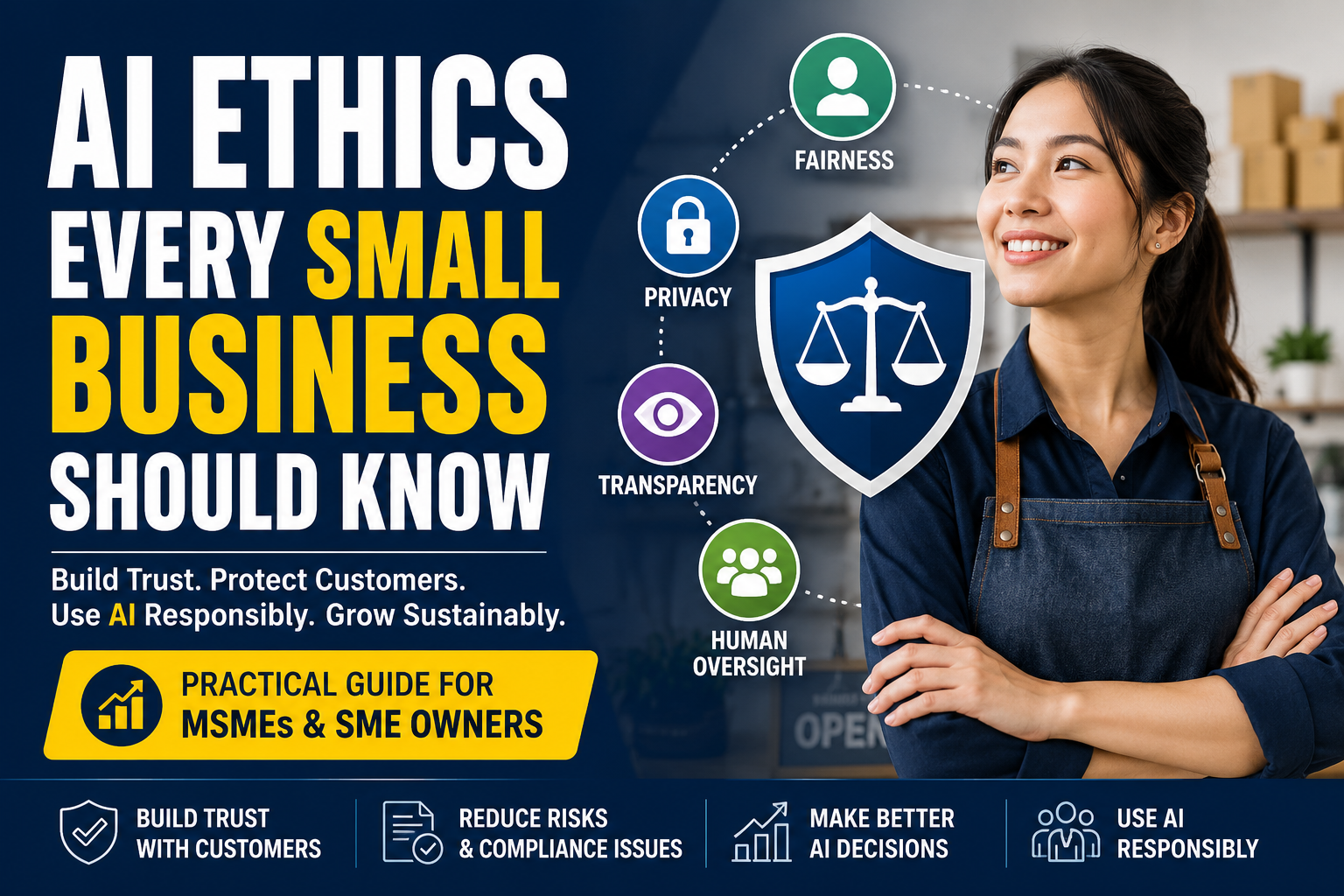
Businesses can also explore our practical guide to AI ethics every small business should know and the guide to AI privacy and data security for related guidance.
When Traditional Methods May Be Better Than AI
AI is not automatically the best solution for every business process. A traditional method may be preferable when a task is already fast, inexpensive, predictable, and easy to perform manually.
For example, a small business may not need an AI system to perform a simple calculation that can be handled reliably with an existing spreadsheet. Introducing AI could add unnecessary complexity without creating a meaningful benefit.
AI is generally more compelling when it addresses a genuine business constraint, such as large volumes of unstructured information, repetitive drafting, complex pattern recognition, or workflows where employees spend substantial time on tasks that can be assisted safely.
Best Practices for Safer AI Adoption
- Start small. Test low-risk applications before automating important decisions.
- Protect sensitive information. Establish clear rules for what employees can submit to AI systems.
- Verify important outputs. Treat AI output as assistance rather than automatic truth.
- Keep humans accountable. Define where human approval remains mandatory.
- Limit access. Give AI applications and users only the permissions they actually need.
- Train employees. Make AI literacy part of normal workplace training.
- Monitor performance. Review whether the AI workflow remains accurate and useful over time.
- Review vendors. Understand important security, privacy, pricing, and availability considerations.
- Document important workflows. Keep a simple record of what the AI does and who is responsible.
- Have a fallback. Critical processes should have a workable alternative if the AI system fails.
NIST's AI RMF emphasizes considering trustworthiness throughout the lifecycle of AI systems rather than treating risk as something to examine only after deployment.
Frequently Asked Questions About Common AI Risks for SMEs
What are the most common AI risks for SMEs?
The most common risks include inaccurate or fabricated outputs, privacy and data exposure, cybersecurity vulnerabilities, biased results, intellectual-property concerns, over-reliance on automation, vendor dependency, unexpected costs, and inadequate human oversight. The importance of each risk depends on the specific AI use case and the consequences of a potential mistake.
Should small businesses avoid AI because of these risks?
No. AI risks are a reason to use AI deliberately, not necessarily to avoid it. SMEs can begin with low-risk tasks, limit access to sensitive information, verify important outputs, and keep people responsible for consequential decisions. The appropriate level of control should reflect the potential impact of the AI application.
Can AI generate incorrect information?
Yes. Generative AI can produce responses that sound confident but contain factual errors, unsupported claims, or fabricated information. NIST refers to this phenomenon as confabulation. Businesses should independently verify important information, particularly when outputs affect customers, finances, legal matters, safety, or business decisions.
What information should SMEs avoid putting into AI tools?
SMEs should be cautious about entering passwords, authentication information, confidential contracts, sensitive personal data, proprietary business information, private customer records, and other information that the business is not authorized to disclose. The exact policy should depend on the AI provider, contractual obligations, applicable privacy requirements, and the sensitivity of the information.
How can a small business reduce AI security risks?
Start by using approved tools, strong authentication, appropriate access controls, limited permissions, employee training, and secure integrations. Avoid giving an AI system unnecessary access to business systems or sensitive information. Important AI-enabled workflows should also have monitoring and a fallback process if the system becomes unavailable or behaves unexpectedly.
Should humans review AI-generated business content?
Human review is particularly important when AI-generated content contains factual claims, customer communications, financial information, legal information, professional advice, or material that could affect the company's reputation. The amount of review can be lower for low-risk brainstorming but should increase as the potential consequences of an error increase.
How should SMEs decide whether an AI workflow is worth using?
Evaluate the workflow based on its actual business outcome rather than novelty. Consider time saved, output quality, total cost, operational risk, employee effort, and the consequences of failure. If AI creates little measurable value while adding substantial complexity or risk, a traditional workflow may be the better choice.
What is the first step toward AI risk management for an SME?
The first step is to create an inventory of how the business currently uses AI. Identify the tools, information they receive, tasks they perform, people who use them, and decisions influenced by their outputs. Once these use cases are visible, the business can prioritize higher-risk applications and add appropriate safeguards.
Conclusion: Manage AI Risk Before Scaling AI Use
The common AI risks for SMEs are manageable when businesses understand where AI can fail and build practical controls around those weaknesses. The most important risks include inaccurate outputs, privacy exposure, cybersecurity problems, bias, intellectual-property concerns, over-automation, vendor dependency, unexpected costs, and insufficient human oversight.
The practical answer is not to eliminate AI. Instead, SMEs should start with clearly defined use cases, protect sensitive information, verify important outputs, restrict unnecessary access, train employees, measure results, and maintain human accountability for consequential decisions.
A good next step is to choose one existing business workflow and perform a simple AI risk review: what data does it use, what could go wrong, what happens if the AI is wrong, who reviews the result, and whether the expected benefit justifies the risk?
Once those questions have clear answers, a small business can expand AI adoption with greater confidence without treating automation as a substitute for responsible business judgment.